
In this post:
1) Moses Expects You to Know About the Sons of God (Angels)
2) Angels over Nations in the Old Testament
3) Angels over Nations in the New Testament
4) This Was Common Knowledge
5) How We Can Get This Common Knowledge
Have you ever been reading your Bible and found yourself thinking that the biblical authors could have been clearer? Do you ever feel like they were assuming that you would know things that you don’t actually know? Well, you’re absolutely correct! They didn’t explain the basics to their audience because their original audience already knew those basics. You, on the other hand, do not know those basics because you live thousands of years in the future and have a completely different set of things that you believe are obvious basics. Allow me a few minutes to prove to you that Moses expects you to know of things about the ancient world that you have probably never imagined.
Moses Expects You to Know About the Sons of God (Angels)
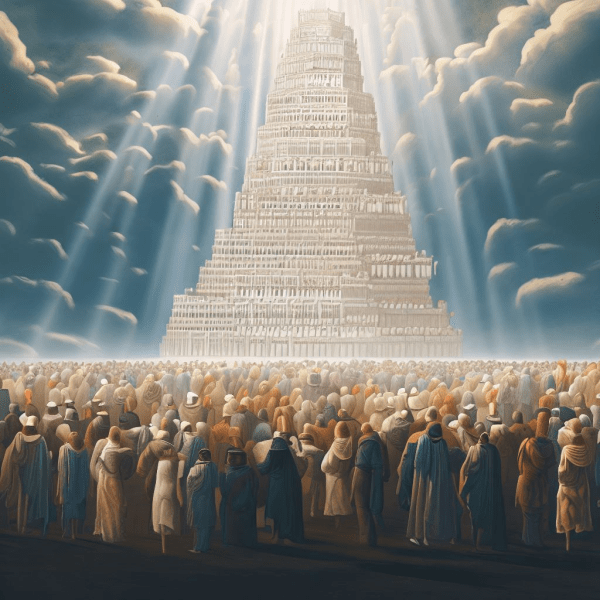
Consider the song of Moses where Moses calls on the people to ask their grandparents and elders about the past. Moses expects those elders to explain that when God divided mankind into nations and gave them their lands to live in, he made angels (the Septuagint translates “sons of God” as ἀγγέλων θεοῦ [“angels of God”]) responsible for each nation, but Israel is an exception in that God has made Israel his own:
Deut 32:7-9 Remember the ancient days; consider the years from generation to generation. Ask your father, and he will declare to you, your elders, and they will speak to you: “When the Most High gave the nations their inheritance, when He separated the sons of man, He set the boundaries of the peoples according to the number of the sons of God. But Yahweh’s portion is His people; Jacob is the allotment of His inheritance.”
Where do we read about when God divided the nations? We read about this in the story of the Tower of Babel in Genesis 11:
Gen 11:1-9 Now the whole earth had one language and the same words. And as people migrated from the east, they found a plain in the land of Shinar and settled there. And they said to one another, “Come, let us make bricks, and burn them thoroughly.” And they had brick for stone, and bitumen for mortar. Then they said, “Come, let us build ourselves a city and a tower with its top in the heavens, and let us make a name for ourselves, lest we be dispersed over the face of the whole earth.” And the LORD came down to see the city and the tower, which the children of man had built. And the LORD said, “Behold, they are one people, and they have all one language, and this is only the beginning of what they will do. And nothing that they propose to do will now be impossible for them. Come, let us go down and there confuse their language, so that they may not understand one another’s speech.” So the LORD dispersed them from there over the face of all the earth, and they left off building the city. Therefore its name was called Babel, because there the LORD confused the language of all the earth. And from there the LORD dispersed them over the face of all the earth.
Moses expected that anyone could read the story of Genesis 11:1-9 and conclude that it was self-evident that at this time God set angels over the nations of the world. Any father or elder in Israel could have explained this obvious fact to you. How silly of you to not realize this!
So, how is it possible that Moses could expect anyone to read Genesis 11:1-9 and conclude that at this time God obviously set angels over the nations? You didn’t come to this conclusion because you haven’t yet learned what was common knowledge for everyone in the ancient world. If you had learned what everyone knew back then, you would also think it was incredibly obvious that God set angels over the nations back in Genesis 11. The logic is as simple as 2+2=4. But before we go into that common knowledge, first let’s see how the whole Bible fully agrees with the idea that angels rule over the nations.
Angels over Nations in the Old Testament

An angel who was sent to bring a message from God to Daniel was kidnapped by the “prince of Persia” and was held as a prisoner by the “kings of Persia”:
Dan 10:12-14 Then he said to me, “Fear not, Daniel, for from the first day that you set your heart to understand and humbled yourself before your God, your words have been heard, and I have come because of your words. The prince of the kingdom of Persia withstood me twenty-one days, but Michael, one of the chief princes, came to help me, for I was left there with the kings of Persia, and came to make you understand what is to happen to your people in the latter days.”
Now, unless we want to say that mere human beings are capable of kidnapping angels, we have to understand the “prince of Persia” and the “kings of Persia” as the fallen angels who rule over the nation of Persia. We see the same idea is Psalms 82 and 89.
Psalm 82:1-8 God has taken his place in the divine council; in the midst of the gods he holds judgment: “How long will you judge unjustly and show partiality to the wicked? Give justice to the weak and the fatherless; maintain the right of the afflicted and the destitute. Rescue the weak and the needy; deliver them from the hand of the wicked.”
They have neither knowledge nor understanding, they walk about in darkness; all the foundations of the earth are shaken.
I said, “You are gods, sons of the Most High, all of you; nevertheless, like men you shall die, and fall like any prince.”
Arise, O God, judge the earth; for you shall inherit all the nations!”
In Psalm 82 we see that the “sons of God” (angels) are responsible for governing the nations and God is not the owner of those nations; the Psalmist has to ask God to inherit the nations at some future time. These sons of God are the gods of the nations. We know that the gods of the nations are real because God doesn’t punish imaginary beings:
Exod 12:12 “I will pass through the land of Egypt that night, and I will strike all the firstborn in the land of Egypt, both man and beast; and on all the gods of Egypt I will execute judgments: I am the LORD.”
The Lord is said to be greater than the sons of God who are in the skies. Since humans did not fly around in the skies, the sons of God are what we would call angels:
Psalm 89:5-7 Let the heavens praise your wonders, O LORD, your faithfulness in the assembly of the holy ones! For who in the skies can be compared to the LORD? Who among the sons of God is like the LORD, a God greatly to be feared in the council of the holy ones, and awesome above all who are around him?
Angels over Nations in the New Testament
Even in the New Testament, Christians are in a battle against multiple powers in the heavens (not just Satan).
Eph 6:2 we do not wrestle against flesh and blood, but against the rulers, against the authorities, against the cosmic powers over this present darkness, against the spiritual forces of evil in the heavenly places.
When Paul says that idols are nothing and that there is no God but one in 1 Cor 8:4-6, he isn’t trying to overthrow the testimony of the rest of the Bible and contradict himself a couple chapters later when he says that the spiritual forces behind idols are demons (1 Cor 10:21).
1 Cor 8:4-6 Therefore, as to the eating of food offered to idols, we know that “an idol has no real existence,” and that “there is no God but one.” For although there may be so-called gods in heaven or on earth—as indeed there are many “gods” and many “lords”— yet for us there is one God, the Father, from whom are all things and for whom we exist, and one Lord, Jesus Christ, through whom are all things and through whom we exist.
1 Cor 10:19-21 What do I imply then? That food offered to idols is anything, or that an idol is anything? No, I imply that what pagans sacrifice they offer to demons and not to God. I do not want you to be participants with demons. You cannot drink the cup of the Lord and the cup of demons. You cannot partake of the table of the Lord and the table of demons.
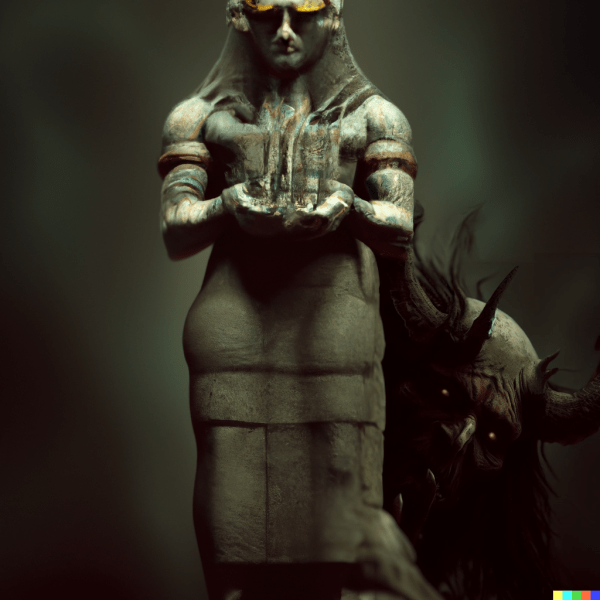
Idols are nothing; they are mere statues. But they represent fallen angels—demons—and Paul does not deny the existence of fallen angels. The gods that the demons pretend to be are fictional; there is no Zues or Baal, but there were demons that took on those names and pretended to be those figures. The angels that God appointed to be over nations fell and became evil, and they are now what we battle against when we go into their domains with the gospel (Eph 6:2).
Now that we’ve seen that the whole Bible agrees with the ideas we’re talking about, let’s get back to that common knowledge that you’re missing.
This Was Common Knowledge
Every author takes it for granted that his audience has access to the common knowledge of his day. For Moses’ audience, it was commonly assumed that every nation and even every city had their own gods who watched over that nation and city. It was also assumed that major events, like the formation of city-states and nations, could not happen unless the divine beings decreed such things to happen. See these beliefs in documents like Enuma Elish:
Enuma Elish 7:112-118 He (the high god whose words determine destiny) shall cause to take place on the earth the counterpart of what has been done in heaven. He shall appoint the peoples to serve. Let the subjected peoples be mindful that they should invoke their gods. At his command let them heed their goddesses. Let them bring food to their gods and goddesses; let these things not be forgotten; let them sustain their gods. Let their holy places be adorned and let them build their temples. Let the peoples be split up amongst the gods.
So, let’s take this common assumption and apply it to the story of the tower of Babel. If supernatural beings are in charge of every nation and no nation can exist without a supernatural being supporting its existence, then the creation of nations during the division of mankind had to have involved supernatural beings being over those nations.
Moses corrects the belief that the gods of the nations are comparable to the Lord, but he never denies the general idea that there are supernatural beings in charge of the nations. He knows that everyone in the ancient world believes in supernatural powers ruling over nations, so he doesn’t bother explaining it. In Moses’ eyes, it is beyond obvious that the Genesis 11 story presupposes that the nations were divided according to the number of angels who were set to rule over the nations. He doesn’t explain this because he expects his readers to have this common knowledge. But how can you gain access to this common knowledge?
How We Can Get This Common Knowledge
The way that people got access to the common knowledge of their day was through living in a world where everyone talked about the same things and assumed the same things. While we can’t go back in time to do the same thing, we can pick up and read texts from the ancient world. There are books like Ancient Texts for the Study of the Hebrew Bible (affiliate link) and The Ancient Near East: An Anthology of Texts and Pictures (affiliate link). The first one summarizes many ancient texts for you and tells you where you can read them yourself, and the second presents for you an anthology of texts and pictures that give you access to the common knowledge of the ancient world.
It takes time to become familiar with the literature from the ancient world. But the benefit is worth the cost. You will begin to see what Moses and the prophets assumed to be true (and didn’t explain to you because they expected you to know it!) and you will see what false beliefs Moses indirectly debunks. Books like The Lost World of Genesis One focus on trying to explain how these ancient texts help us understand our Bibles, but they are often written by scholars with bad theological presuppositions like John Walton (see this podcast for a discussion on John Walton).
This blog will mention many helpful insights from the ancient world, but nothing compares to taking the time to see things for yourself and thinking them through on your own.


 VersesVersusVanity
Leave a reply to The Sons of God controversy – Kanisa la Christadelphian huko Anderlecht Cancel reply