
In this post:
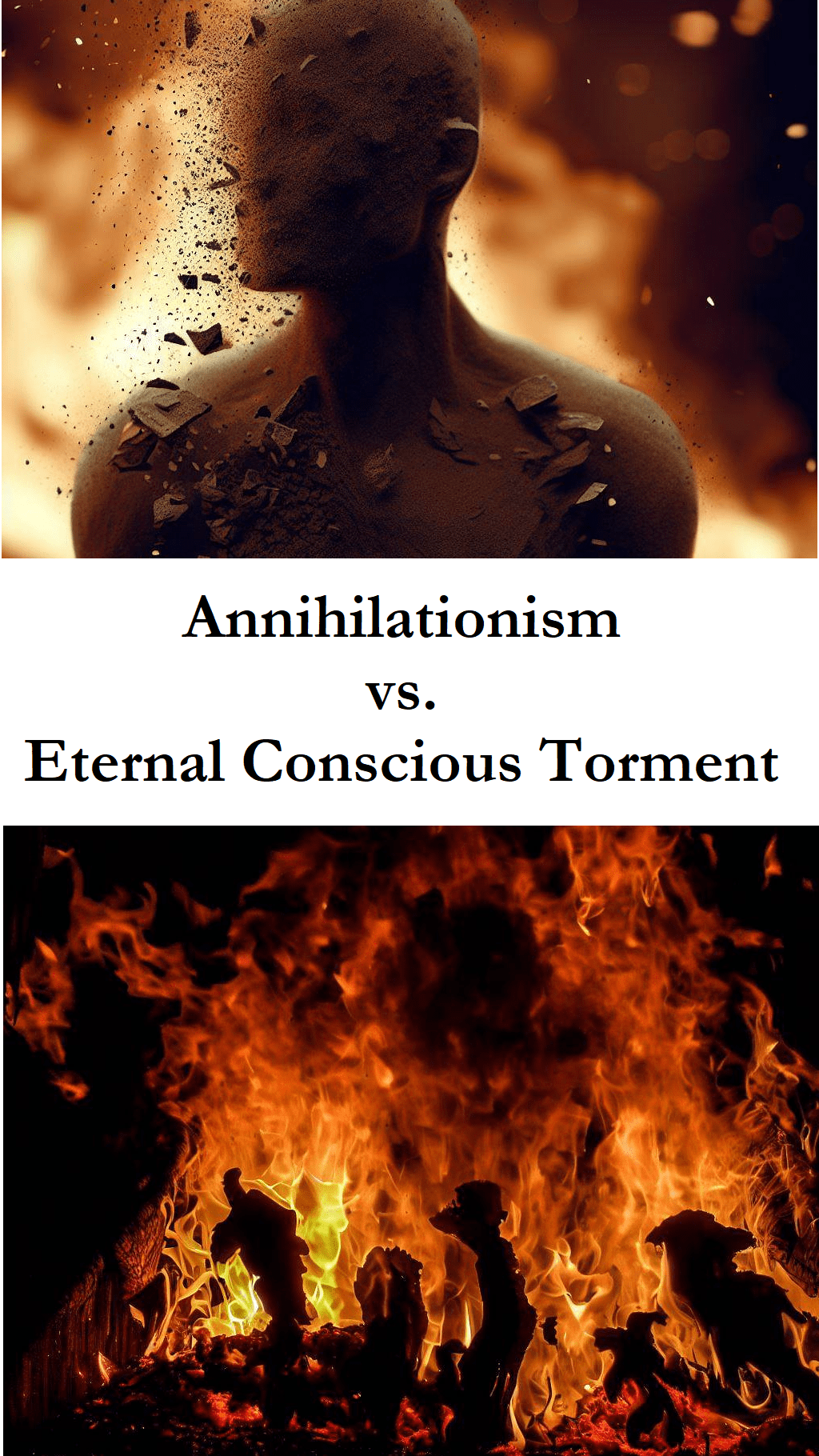
Jesus says that souls are destroyed–does this prove annihilationism?
What about the other words that have to do with destruction?
Peter and Jude testify to eternal conscious torment.
Conclusion: Eternal Conscious Torment wins.
Jesus & Paul’s Terminology: Destruction?
Jesus says to fear the one who can destroy both the body and soul in Gehenna (the Lake of Fire) and Paul says that the fate of the damned is to perish/be destroyed. The Annihilationists argue that these descriptions are most naturally read as the annihilation of the wicked, not the eternal torture of the wicked.
Matthew 10:28 And do not fear those who kill the body but are unable to kill the soul; but rather fear Him who is able to destroy both soul and body in Gehenna.
2Thess 1:9 These will pay the penalty of eternal destruction (away?) from the presence of the lord and from the glory of his might,
Phil. 1:28 in no way alarmed by your opponents—which is a sign of destruction for them, but of salvation for you, and that too, from God.
Phil. 3:19 whose end is destruction, whose god is their stomach and glory is in their shame, who set their thoughts on earthly things.
In order for us to determine exactly what is meant we have to look at the original Greek texts and think about the meaning of the words that Paul and Jesus use.
ὄλεθρος (olethros “destruction, death, corruption”)
In 2 Thess 1:9, Paul says that the wicked will suffer eternal olethros. This olethros could either be understood as coming from God or taking place apart from God; Paul’s wording here is ambiguous. Regardless of which one was meant, the meaning of the term is essential. What does it mean?
olethros – Corruption
In the writings of Herodotus, we see that the word is used to describe a corrupt individual and we see the same type of meaning in 1 Timothy.
Herodotus’ Histories Book III:142 You are not worthy to reign over us, being a low-born knave and corrupt (olethros). See to it rather that you give an account of the moneys that you have handled.
1Timothy 6:9 But those who desire to be rich fall into temptation, into a snare, into many senseless and harmful desires that plunge people into corruption (olethros) and ruin (apoleia – discussed below).
olethros – Destruction
In Plutarch’s history of Crassus, he describes Crassus’ passionate attempt at defeating the Parthian Empire, which resulted in both the destruction of his armies (the public calamities) and his own death.
Plutarch Life of Crassus And his passion gave him no rest nor peace until it ended in an inglorious death (olethros) and public calamities.
It isn’t clear whether any texts in the New Testament ever require olethros to be about destruction, but it is possible to interpret some that way (1 Cor 5:5; 1 Thess 5:3).
1Cor. 5:5 deliver such a one to Satan for the destruction/corruption of his flesh, so that his spirit may be saved in the day of the Lord.
It would be a bit odd for Paul to expect that handing someone over to Satan in 1 Cor 5:5 for the destruction of the body would result in that person being saved when Jesus returns, unless he only has partial destruction in mind (the man begins to have his body destroyed by Satan and then repents, turns to God, and is saved). This partial-destruction view would fit better with the idea of corruption.
1Thess 5:3 While they are saying, “Peace and safety!” then destruction/corruption will come upon them suddenly like labor pains upon a woman who is pregnant, and they will never escape.
The text of 1 Thess 5:3 makes sense both as being about utter destruction or about corruption of the body and spirit by divine punishment. It isn’t clear which is meant.
So, 2 Thess 1:9 is ambiguous as to whether it is about eternal destruction or corruption. It is better to look for clearer texts than it is to try to make this ambiguous text answer our questions.
ἀπώλεια (apoleia “annihilation, ruin”)
In Phil 1:28 and 3:19, Paul says that apoleia is the fate of the wicked. But what does this term mean? Let’s look at the uses that came before Paul (Aristotle and Diodorus) and one contemporary of Paul (Josephus):
In Aristotle’s Nicomachean Ethics (340 BC), apoleia has to do with ruining someone without annihilating that person.
Diodorus Siculus (36 BC) used apoleia three times in his The Library of History, each time the word is used to communicate the annihilation of boats or men.
Josephus (90 AD) uses the term once to describe people being crushed beyond recognition and twice in a way that is ambiguous between annihilation and simply being ruined.
The disciples of Jesus use apoleia to describe what they thought was a waste of perfume on Jesus (Matt 26:7-8). The perfume was not annihilated from existence; it was used in an unprofitable way and was wasted in their eyes.
Matt. 26:7-8 a woman came to Him with an alabaster jar of very costly perfume, and she poured it on His head as He reclined at the table. But when the disciples saw this, they were indignant, saying, “Why this waste (apoleia)?”
It appears that this term apoleia could be used for either annihilation or being placed into a pathetic and ruined state.
ἀποκτείνω (apokteino “to kill, destroy”)
Jesus says to fear the one who can destroy (apokteino) both the soul and the body in Gehenna (Matt 10:28). The soul is the whole being of the person, not just the body. So, if the whole being of a person is destroyed, then the Annihilationist position has a very strong argument in its support.
The term apokteino unambiguously has to do with ending the life of some creature or person, both in the entire Bible and in Greek literature. For God to end the life of someone’s soul—someone’s whole being—then it seems that God is annihilating that person from existence.
The eternal torment view takes this verse to mean that God continually kills the individual while keeping him alive, but there is nothing in the grammar of Matt 10:28 to give the impression that there is an eternal process of killing being described. If it can be shown that some other part of the Bible unambiguously declares that the wicked will be tortured forever, then this verse would have to be understood as being about a process of dying that is endless and beyond our imagination.
Authors are able to ‘coerce’ new meanings from words when they are used in contexts where the usual meaning is improbable. If any texts can be shown to unambiguously support eternal conscious torment, then Jesus must be viewed as coercing a new meaning out of this term that usually has to do with annihilation. But on its own, this verse only supports the annihilationist view.
Terminology Conclusion
Paul’s terminology is ambiguous; he could be talking about ruin/corruption or annihilation. Jesus’ terminology, however, is not ambiguous. The only way Jesus is not talking about annihilation taking place in Gehenna is if some other text in the Bible clarifies the matter so that we have to interpret Jesus in a way that doesn’t fit with the usual usage of apokteino (“to kill, destroy”). So, we turn to Peter and Jude.
Peter and Jude
Jude
The book of Jude contains descriptions of wicked people who are to spend eternity in the darkness:

Jude 10-13 But these people disparage all the things that they do not understand; and all the things that they know by instinct, like unreasoning animals, by these things they are destroyed. Woe to them! For they have gone the way of Cain, and for pay they have given themselves up to the error of Balaam, and perished in the rebellion of Korah. These are the ones who are hidden reefs in your love feasts when they feast with you without fear, like shepherds caring only for themselves; clouds without water, carried along by winds; autumn trees without fruit, doubly dead, uprooted; wild waves of the sea, churning up their own shameful deeds like dirty foam; wandering stars, for whom the gloom of darkness has been reserved forever.
The language of “forever” is invoked for these people. If they are annihilated, they will hardly spend forever in the darkness. It might be possible to argue that the darkness is a euphemism for non-existence, but Jesus uses the same language and says that people are both sad and angry in the darkness.
Matt 8:12 but the sons of the kingdom will be thrown out into the outer darkness; in that place there will be weeping and gnashing of teeth.”
Matt 22:13 Then the king said to the servants, ‘Tie his hands and feet, and throw him into the outer darkness; there will be weeping and gnashing of teeth in that place.’
If people are sad and angry while they are in the darkness, then the darkness is not a euphemism for nonexistence. Also, it makes little sense to say that a location (the darkness) has been reserved for people who no longer exist; this text presupposes the eternal existence of those who are cast into the darkness.
Peter
Peter speaks of both the angels who rebelled and wicked people as both being destroyed in the final destruction. It is the corrupt heavenly powers led by the devil who are said to be tortured forever in Revelation 20:10; the beast and the false prophet are probably best understood as fallen angelic powers who ruled over human institutions that opposed God (Matt 25:41), not the human beings themselves (although, it is possible that the humans through whom they worked are included). Their destruction, then, is an eternal process of being destroyed according to Rev 20:10. And if humans share in that particular type of destruction, then it seems like eternal conscious torment is the fate of the wicked.

2 Pet 2:10-12 especially those who indulge the flesh in its corrupt passion, and despise authority. Reckless, self-centered, they speak abusively of angelic majesties without trembling, whereas angels who are greater in might and power do not bring a demeaning judgment against them before the Lord. But these, like unreasoning animals, born as creatures of instinct to be captured and killed, using abusive speech where they have no knowledge, will in the destruction of those creatures also be destroyed,
Rev. 20:10 And the devil who deceived them was thrown into the lake of fire and brimstone, where the beast and the false prophet are also, and they will be tormented day and night forever and ever.
In order to avoid this conclusion, one would have to argue that the fallen angels Peter is talking about are a different group from the ones spoken about in Rev 20:10. To me, this doesn’t seem very likely. I take this verse as supporting eternal conscious torment of the wicked in the Lake of Fire.
Another way that an Annihilationist may try to avoid the conclusion of eternal conscious torment is by claiming that even “tormented day and night forever and ever” actually means “will cease to exist eventually.” This argument strikes me as trying to avoid the obvious meaning of the text. If even language like “event X will take place day and night forever and ever” means “event X will come to an abrupt and permanent end,” then it is impossible to ever communicate the idea that something goes on eternally.
Summary
There were church fathers on both sides of the issue from the beginning.
Ancient Near Eastern Context
The ancients generally believed in the immortality of the spirit, which logically required that punishments would be eternal and rewards would be eternal. However, some Egyptians entertained the notion of annihilationism. So, neither view can be claimed to be the only view held in the ancient world.
We saw that the intertestamental literature supports both Annihilationism and eternal conscious torment.
The concept of eternal life in the Bible is more than just eternal existence; it is eternal existence in beautiful harmony with God. A person who lives forever as an enemy of God while being punished does not have eternal life as the Bible depicts eternal life.
Bible’s Focus
The focus of the Bible is upon the created world, not other realms. When the Bible speaks of the wicked being no more, it doesn’t mean that they don’t exist in some other realm, it means that they are not in God’s world, whether this one or the New Earth that God will establish.
Language of Eternal Suffering
We saw that much of the language that is commonly taken to communicate eternal torment is actually more ambiguous than is often assumed. Either view could be understood in these verses.
New Testament Language
Much of the New Testament language was ambiguous and can be taken as being about annihilationism or about eternal suffering. The verse that most strongly supported annihilationism was Jesus’ mention of the destruction of wicked souls, but even that verse could be understood to support eternal conscious torment. Peter and Jude both wrote in ways that strongly support eternal conscious torment.
Final Conclusion
In my assessment, eternal conscious torment is the stronger of the two positions. However, there needs to be humility and understanding between fellow believers. Many texts are ambiguous, and words like “destroy,” which are used by most translations, appear to support Annihilationism.
The matters of first importance (1 Cor 15:1-5) do not involve getting the Annihilationism vs. Eternal Conscious Torment debate settled. Frankly, since this has zero impact on any practical aspect of Christian living (the command to evangelize exists whether you think the consequences are annihilation or torment), I wouldn’t even place it in the realm of secondary matters.
So, when we have a situation where there is a lot of ambiguity, it is vital that Christians be gracious to each other when there is disagreement. It is a terrible thing when tertiary issues become reasons for division and conflict.


Leave a Reply