
In this post:
Does the Old Testament promise of wicked people ceasing to exist prove Annihilationism?
Why unquenchable fire doesn’t have to be eternal.
Why eternally ascending smoke isn’t eternal.
Lake of Fire
What World Does the Old Testament Focus On?

The Annihilationist position correctly points out that there are many verses about the wicked being destroyed and no longer existing in the Old Testament. If they cease to exist, then doesn’t that prove that they are annihilated out of existence?
Isa. 37:20 But the wicked will perish; the enemies of Yahweh will be like the glory of the pastures; they vanish—in smoke they vanish away.
Is. 33:12 The peoples will be burned to lime, like cut thorns which are burned in the fire.
Psa. 1:4 The wicked are not so, but they are like chaff which the wind drives away.
Psa. 34:16 The face of Yahweh is against evildoers, to cut off the memory of them from the earth.
Psa. 73:19 How they become desolate in a moment; they are completely swept away by terrors! Like a dream when one awakes, O Lord, when aroused, you will despise their form.
Obad. 16 They will drink and swallow, and they will be as if they never were.
So, we need to ask whether the Old Testament authors were writing from the perspective of people living in this world, or whether they were speaking from God’s perspective where he oversees all realities. If the Old Testament authors were speaking from God’s perspective, then the wicked should be cut off from existing in any realm of existence, whether on earth or in the afterlife. But if the Old Testament authors were speaking from the perspective of someone alive in our world, then they could speak of the wicked being removed from the world without implying that they would also cease to exist in the afterlife.
As far as I can tell, the Old Testament authors spoke from the perspective of people alive in the world. So, if the wicked are not in the New Earth and there is no trace of their former existence in the world nor a recollection of them, then these passages are fulfilled despite the fact that these wicked people exist in some other realm called the Lake of Fire.
Added to this is the fact that all of these verses were written to people who assumed that there was an afterlife (see posts one and two on Hell). There is no verse in the Old Testament where the wicked are spoken of as being annihilated from the afterlife; every verse on the annihilation of the wicked fits best with being from the perspective of a person on earth who watches the wicked disappear from the world. The assumption would not be that they were annihilated from every possible plane of existence, but that they went to the afterlife that almost everyone (except for some Egyptians) believed was eternal.
New Testament Terminology: Not as Clear as You Might Think
Unquenchable fire
The mention of unquenchable fire has often been understood as fire that burns for eternity. Why would Jesus speak of a fire that never ends unless the people who were thrown into it would experience that fire for eternity? It makes little sense to mention that the fire that annihilates a person would go on to exist forever after that person has been annihilated. However, that’s not the only way to understand ‘unquenchable.’ The meaning could have to do with the fire not being able to be put out until the object has been fully burned up. This would mean that sinners thrown into the fire would find themselves unable to put the fire out that is burning them and so would burn until they are consumed and no longer exist. So, these verses could be understood either way, right? Not quite. Although Mark 9:43 speaks of unquenchable fire, the parallel text in Matthew 18:8 clarifies this unquenchable fire as being eternal fire.

Matt. 3:12 His winnowing fork is in His hand, and He will thoroughly clear His threshing floor, and He will gather His wheat into the barn, but He will burn up the chaff with unquenchable fire.”
Mark 9:43 And if your hand causes you to stumble, cut it off; it is better for you to enter life crippled, than, having your two hands, to go into Gehenna, into the unquenchable fire,
Matt 18:8 And if your hand or your foot is causing you to sin, cut it off and throw it away from you; it is better for you to enter life maimed or without a foot, than to have two hands or two feet and be thrown into the eternal fire.
Nevertheless, it is possible to argue that the language of “the eternal life” is only meant to clarify that this is the same eternal fire that has been prepared for the devil and his angels (Matt 25:41). An Annihilationist may argue that the fire is eternal because the torment of the devil and his angels is eternal, not because the torment of the humans who are also thrown in there is eternal. It is possible that the devil and his angels are tormented eternally by the same fire that annihilates human souls; the difference between the humans and the angels would be that God does not choose to sustain the existence of humans in that fire eternally while he does choose to do so for the devil and his angels. We will return to this discussion in the third post that discusses Revelation 20:10.
Undying Worms
Jesus also mentions that in Gehenna (the Lake of Fire), the worms that consume people do not die. This could be understood to mean that the maggots will be eating the unbeliever’s resurrected body for eternity. Alternatively, it could mean that the fire will not kill the worm that is consuming the unbeliever, and maybe also that the maggot will outlive the normal lifespan of a maggot (5-6 days) in order to have enough time to finish eating the body. If Jesus has Isa 66:24 in mind when he says this, then this verse most naturally supports Annihilationism.

Mark 9:47-48 And if your eye causes you to stumble, gouge it out; it is better for you to enter the kingdom of God with one eye, than, having two eyes, to be cast into Gehenna, where their worm does not die, and the fire is not quenched.
Is. 66:24 Then they will go forth and look on the corpses of the men who have transgressed against Me. For their worm will not die and their fire will not be quenched and they will be an object of contempt to all mankind.
If the resurrection to the Lake of Fire results in corpses being burned and eaten by worms, this does not fit very well with the idea of eternal suffering. Corpses are by definition lifeless; they do not have spirits and are not living creatures being tormented. In order to still support the idea of eternal torment, we’d have to claim that the unbeliever’s spirit exits the corpse and then suffers in the fire as well. This is a reasonable assumption, so long as there are clear verses to support the eternality of the afterlife for the wicked.
Revelation 14:11
One of the major supporting verses for eternal conscious torment is Revelation 14:11. We will consider both the eternal smoke and the restless days and nights.
Rev 14:11 And the smoke of their torment goes up forever and ever; they have no rest day and night, those who worship the beast and his image, and whoever receives the mark of his name.
Eternally Ascending Smoke
Those who support Annihilationism point out that the Old Testament uses the language of smoke that ascends forever in a poetic way that cannot mean that the smoke literally ascends forever. In Isaiah 34, the land of Edom is spoken of as being destroyed, covered in blood, and smoking eternally. However, the pelicans and hedgehogs who are claimed to live there afterward cannot be living in smoke, so the text itself doesn’t present a situation where the smoke keeps on billowing. Furthermore, anyone who travels to Edom today will notice that there isn’t an eternal fire that is forever putting forth smoke. If this verse is about literal smoke going up forever from the land of Edom, then it is a false prophecy because anyone can go and look and see with their own eyes that there is no eternal smoke going up from Edom.

Is. 34:5, 7, 10-11 For My sword is satiated in heaven; Behold, it shall descend for judgment upon Edom and upon the people whom I have devoted to destruction… Thus their land will be soaked with blood, and their dust become greasy with fat… It will not be quenched night or day; Its smoke will go up forever. From generation to generation it will be laid waste; None will pass through it forever and ever. But pelicans and hedgehogs will possess it, and owls and ravens will dwell in it.
We have to conclude that eternally arising smoke is poetic language that has to do with the eternal consequences of destruction. The Edomites never rebuilt Edom; the kingdom of Edom is eternally gone. The people who currently live in the land that formerly was Edom are not Edomites and they do not represent the kingdom of Edom. However, just because an expression in Isaiah was not literal, that does not mean that the Revelation text is not literal. Similar expressions can have different meanings in different contexts.
So, Rev 14:11’s mention of eternally ascending smoke could either be about eternal torment or about the eternal consequence of the torment of being burned to annihilation. The reader has to determine which makes more sense in the book of Revelation as a whole. This text by itself is ambiguous.
No Rest Day or Night
Rev 14:11 also speaks of the wicked having rest neither day nor night. This could be interpreted as their eternal state, but the text does not say that they have rest neither day nor night for all of eternity. If I told you that a North Korean prisoner has no rest day or night, you would not assume that this is a statement about eternity; you’d understand that I only mean that it is true while he is alive. If you think that the smoke literally rises eternally, then the wicked have no rest eternally. If you think that the eternally rising smoke is symbolic of eternal consequences of destruction, then the wicked have no rest all the way until their annihilation from existence. Alternatively, some Annihilationists take “no rest day or night” as symbolically communicating that they will never enter into God’s rest (Heb 4:3) because they will cease to exist.
Lake of Fire
In the four verses that speak about the Lake of Fire, we very clearly see that the devil, the false prophet, and the beast are all tormented day and night for all of eternity. We also see that unbelievers are thrown into the Lake of Fire (Rev 20:15), but this verse does not say that these people will similarly suffer forever in the Lake of Fire. This verse could support either position.
If we understand Isa 66:24 to be about the Lake of Fire, then it seems like those people are thrown into the Lake of Fire, die, become corpses, and then are burned up. Possibly their spirits continue on in the Lake of Fire and suffer from the flames in some spiritual sense like the devil does. However, no verse unambiguously makes such a claim. So, we could understand their spirits as being annihilated or we could view their spirits as continuing on in a state of suffering for all of eternity.
Rev. 19:20 And the beast was seized, and with him the false prophet who did the signs in his presence, by which he deceived those who had received the mark of the beast and those who worshiped his image. These two were thrown alive into the lake of fire which burns with brimstone.
Rev. 20:10 And the devil who deceived them was thrown into the lake of fire and brimstone, where the beast and the false prophet are also, and they will be tormented day and night forever and ever.
Rev. 20:15 And if anyone’s name was not found written in the book of life, he was thrown into the lake of fire.
Rev. 21:8 But for the cowardly and unbelieving and abominable and murderers and sexually immoral persons and sorcerers and idolaters and all liars, their part will be in the lake that burns with fire and brimstone, which is the second death.
Death and Hades are also thrown into the Lake of Fire (Rev 20:14). Annihilationists take this to mean that both death and Hades cease to exist. However, those in support of eternal torment could argue that those who are in the Lake of Fire continue to experience the agony of dying for all of eternity, and the agonies of Hades accompany them in the Lake of Fire in addition to whatever new suffering is present in the Lake of Fire. So, this verse can also support either view.
Summary So Far
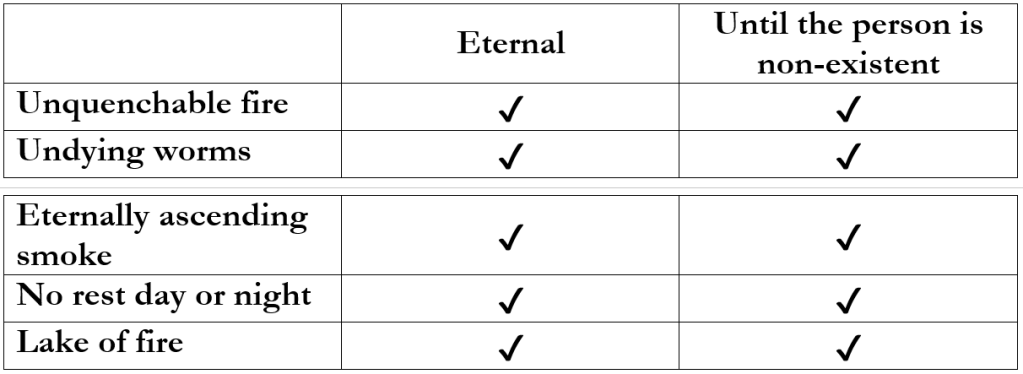
In the chart below we see that none of the verses that are commonly presented to prove eternal torment are decisive. Each one can be understood in either direction, sometimes depending upon whether the New Testament author is using a similar phrase with the exact same meaning that it had in its Old Testament context.
Up Next
Finally, in our next post, we will discuss the texts that the Annihilationists put forward as their strongest evidence for their position. We will then come to our conclusion as to who has the most biblical position.
 VersesVersusVanity
Leave a comment