

If you were to read most translations of Isaiah 7:16 in English, you would find historically inaccurate information that, in addition to making the Bible look erroneous, also makes it very difficult to see how Jesus could be the fulfillment of the prophesy about Immanuel. Jewish rabbis often use this error to argue against Jesus being Immanuel. In this post we will correct the mistaken modern translations and prove that in this case, the King James Version provides the only translation that doesn’t contradict historical facts.
The Historical Error
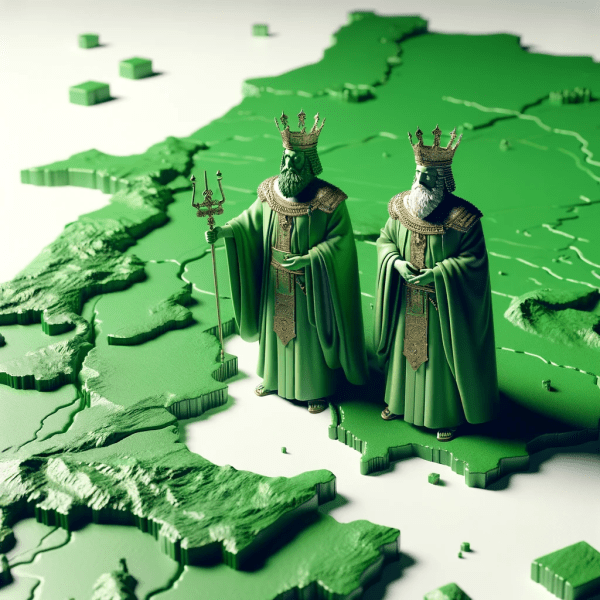
Let’s look at a sampling of modern translations that all share in the same historical error (bolded):
Therefore the Lord Himself will give you a sign: Behold, the virgin will be with child and bear a son, and she will call His name Immanuel. He will eat curds and honey in order that He will know to refuse evil and choose good. For before the boy will know to refuse evil and choose good, the land whose two kings you dread will be forsaken. (Isaiah 7:14–16 LSB)
Therefore the Lord himself will give you a sign. Behold, the virgin shall conceive and bear a son, and shall call his name Immanuel. He shall eat curds and honey when he knows how to refuse the evil and choose the good. For before the boy knows how to refuse the evil and choose the good, the land whose two kings you dread will be deserted. (Isaiah 7:14–16 ESV)
Therefore the Lord himself will give you a sign: The virgin will conceive and give birth to a son, and will call him Immanuel. He will be eating curds and honey when he knows enough to reject the wrong and choose the right, for before the boy knows enough to reject the wrong and choose the right, the land of the two kings you dread will be laid waste. (Isaiah 7:14–16 NIV)
The problem with these translations, and almost every other translation, is that they all speak erroneously of Syria and Ephraim as a single land that has two kings. Contextually, the two kings must be understood as the ones mentioned in Isaiah 7:8-9, namely Rezin of Syria and the son of Remaliah of Ephraim.
For the head of Syria is Damascus, and the head of Damascus is Rezin. And within sixty-five years Ephraim will be shattered from being a people. And the head of Ephraim is Samaria, and the head of Samaria is the son of Remaliah. (Isaiah 7:8–9 ESV)
Syria and Ephraim are two separate lands, not one land with two kings. Nobody refers to Canada and the USA as one land with two leaders, nor to Germany and Poland as one land with two governments. Perhaps if there were one country that recently split into two countries, there would be a period of time when we could speak hypothetically of there being one land with two governments, but that type of speech and viewpoint would not last more than a generation or two. There is no historical precedent in the days of Isaiah to speak of Syria and Ephraim as one land with two kings and there are no texts from the ancient world that ever speak of two countries who join their armies on a military campaign as being one land with two kings. The translators who chose to make the two countries of Syria and Ephraim sound like they were one country with two kings made the Bible speak erroneously when there was no necessity for doing so.
There is only one land in the Bible that has two kings, and that is the land of Israel that was divided between northern Israel (Ephraim) and southern Israel (Judah). Even after the division of North and South, although Isaiah often clearly recognizes a distinction between Judah and Ephraim, he oscillates between using Israel to refer to both Judah and northern Israel, and just using Israel to refer to northern Israel. God speaks of Israel as having two dynasties (Isa 8:14) and speaks of Judah and Israel as being one vineyard (Isa 5:7). From God’s point of view, as expressed by Isaiah, there are two kings in his singular land.
But the LORD of hosts, him you shall honor as holy. Let him be your fear, and let him be your dread. And he will become a sanctuary and a stone of offense and a rock of stumbling to both houses of Israel, a trap and a snare to the inhabitants of Jerusalem. (Isaiah 8:13–14 ESV)
For the vineyard of the LORD of hosts is the house of Israel, and the men of Judah are his pleasant planting… (Isaiah 5:7 ESV)
If it is historically inaccurate to claim, as so many rabbis do, that the land with two kings is Syria and Ephraim, then we are forced to take the only historically viable possibility, namely that God is speaking about the land of Israel. But what sense would this revision make?
Therefore the Lord himself will give you a sign. Behold, the virgin shall conceive and bear a son, and shall call his name Immanuel. He shall eat curds and honey when he knows how to refuse the evil and choose the good. For before the boy knows how to refuse the evil and choose the good, the land whose two kings (yourself and the son of Remaliah) you dread will be deserted. (Isaiah 7:14–16 ESV)

If Ahaz abhors the two kings, and he is one of those kings, then he abhors himself! Either this is a statement about Ahaz’s emotional and mental difficulties, or the translation is sadly mistaken. In this case, the King James Version reflects a proper understanding of the Hebrew grammar:
For before the child shall know to refuse the evil, and choose the good, the land that thou abhorrest shall be forsaken of both her kings. (Isaiah 7:16 KJV)
It is the land, not the two kings, which Ahaz abhors. So, we don’t need to theorize about Ahaz’s self-abhorrence; he doesn’t abhor himself–he abhors the land of Israel.
Although the KJV gets the idea right that it is the land and not the kings that Ahaz has a problem with, we can still potentially improve upon the translation. Every Biblical Hebrew lexicon shows that there are actually two possible translations for the word qāṣ that is translated as abhor by the KJV: abhor or destroy. Contextually, it is very difficult to tell which one Isaiah intended when he wrote. The following verses (Isa 7:17-25) speak about how the king of Assyria will come and bring destruction to the land. Ahaz is the one who bribes the king of Assyria with a huge amount of money, which results in the prophesied destruction of all of Judah (except Jerusalem) at the hands of Assyria’s general Sennacherib. Should Ahaz’s actions that bring the destruction of Judah be considered as him abhorring Judah or as him destroying Judah?
Then Rezin king of Syria and Pekah the son of Remaliah, king of Israel, came up to wage war on Jerusalem, and they besieged Ahaz but could not conquer him. At that time Rezin the king of Syria recovered Elath for Syria and drove the men of Judah from Elath, and the Edomites came to Elath, where they dwell to this day. So Ahaz sent messengers to Tiglath-pileser king of Assyria, saying, “I am your servant and your son. Come up and rescue me from the hand of the king of Syria and from the hand of the king of Israel, who are attacking me.” Ahaz also took the silver and gold that was found in the house of the LORD and in the treasures of the king’s house and sent a present to the king of Assyria. And the king of Assyria listened to him. The king of Assyria marched up against Damascus and took it, carrying its people captive to Kir, and he killed Rezin. (2 Kings 16:5–9 ESV)
Had Ahaz listened to Isaiah’s warning in Isa 7:1-9 to trust God and not look to pagans like the king of Assyria for help, the destruction would not have befallen Israel (northern and southern). It is because Ahaz was ignoring God’s words through Isaiah that he qāṣ the land of Israel (both north and south). He abhorred the land by ignoring the God who would have protected it from the king of Assyria, and so invited God to use Assyria as a rod of judgment. He also destroyed the land (both north and south) through ignoring God and bribing the destroyer to come into their midst. Both possible translations make sense.
So, what meaning does this prophecy have for Ahaz? It tells him that not only will God remove the dynasty of the northern kingdom, but God will also remove the dynastic line of Ahaz from Judah as well. So, while he would not see this day come, he would be disturbed to hear that God viewed him as a destroyer of the land and that God planned on removing his line from ruling over the land.
How the Error Muddies the Prophecy about Immanuel

Now that we perceive that Isaiah speaks of a time when Israel no longer has either of its two dynasties remaining, we have to understand the virgin birth as having taken place sometime after the Babylonian captivity. With this in place, we can clearly understand that the following verses (Isa 7:17-25) are not about what the Immanuel prophecy signifies, but rather are just an explanation of what God meant when he said that Ahaz was abhorring/destroying the land of Israel.
If we don’t have a translation that makes it clear how Isa 7:16 relates to Isa 7:17-25, then the most natural reading of the text is that the Immanuel prophecy has to do with the coming of the Assyrian king and the destruction of Judah in the days of Ahaz. After all, what good explanation would there be for Isa 7:17-25 to be written after 7:16?
“Yahweh will bring on you, on your people, and on your father’s house days which have never come since the day that Ephraim separated from Judah—the king of Assyria!”
And it will be in that day, that Yahweh will whistle for the fly that is in the remotest part of the rivers of Egypt and for the bee that is in the land of Assyria. And they will all come and rest upon the steep ravines, on the crevices of the cliffs, on all the thorn bushes, and on all the watering places.
In that day, the Lord will shave with a razor—one hired from regions beyond the River (that is, the king of Assyria)—the head and the hair of the legs; and it will also remove the beard.
And it will be in that day, that a man may keep alive a heifer and a pair of sheep; and because of the abundance of the milk produced, he will eat curds, for everyone that is left within the land will eat curds and honey.
And it will be in that day, that every place where there used to be one thousand vines, valued at one thousand shekels of silver, will become briars and thorns. People will come there with bows and arrows because all the land will be briars and thorns. As for all the hills which used to be cultivated with the hoe, you will not go there for fear of briars and thorns; but they will become a place for pasturing oxen and for sheep to trample.” (Isaiah 7:17–25 LSB)
So, rabbis have taken this common bad translation as proof that the ‘virgin birth’ happened in the days of Ahaz, and they use this as evidence against Jesus being the fulfillment of the prophecy. Conservative scholars, who have erred in treating the bad translation as if it were acceptable, have tried to get around this problem by claiming that the ‘virgin birth’ happened in the days of Ahaz and again with Jesus. They do this by claiming that the word translated as ‘virgin’ does not really mean virgin, but instead merely means young woman. We will see why they are badly mistaken in making this claim in our next post. But for the moment, it is worth pointing out that a prophecy about an extremely common event is a worthless prophecy; if I said that the proof that I am a prophet is my ability to predict that rain will happen sometime in the next ten years, you would be right to laugh at me for my ridiculous ‘prophecy.’ Predicting that some young woman in Judah will give birth to a child is no more impressive than predicting that it will rain sometime in the next ten years. A prophecy like this is the type of prophecy we should expect from scam artists, not from the God who does miracles.
In reality, God’s prophecy of the virgin birth that he gave to through Isaiah is fulfilled one time in history in Jesus Christ. It took place after the Babylonian captivity when neither dynasty continued to reign in the land of Israel (the prophecy said that the land of Israel would lack any kings by the time Immanuel learns to choose between good and evil). When we take the Bible as being a historically accurate document and don’t choose to translate it in ways that make it historically inaccurate, we are enabled to see the great specificity with which God predicted the future.
 VersesVersusVanity
Leave a comment