
In this post:
• Date of Enuma Elish
• Parallels
‣ 7 tablets vs. 7 days
‣ Creation order
‣ Rest
‣ Purpose of Humanity
‣ Purpose of the universe
‣ Creation of Man
• Takeaways from Enuma Elish
Introduction
In the previous post on Ancient Near Eastern texts that show concepts that are remarkably similar to Genesis 1-3, we argued that the similarities are based on the fact that once humanity dwelt together and shared a common history and theology. Of all the texts from the ancient world that have parallels to Genesis 1, the story of Enuma Elish contains the most. In this post we will look at the most significant similarities and try to understand what they mean for us as readers of the Bible.
Date of Enuma Elish
The oldest tablets of Enuma Elish that we possess are from 1000 BC. Clearly, they date long after Moses. However, these are just copies of even older tablets. So, we can’t use their date to inform us when Enuma Elish was originally writtenְ. Instead, we have to look at other evidence.
When we look at the Agume Kakrime inscription by King Agume II (15th c. BC), we see that he claims to have covered the doors of Marduk’s temple with images of the same monsters that are listed as Marduk’s opponents in Enuma Elish. Based on such art, it appears that the story of Marduk defeating these monsters was already well-established.
| Enuma Elish (I:141-143) | Agume Kakrime (IV:42-50) |
| She (Tiamat) deployed: vipers, dragons, hairy hero-men, wild dogs, lion men, mighty demons, fish-men, and bull-man | I set the upper door with a band of copper that had: vipers, hairy hero-men, a bull-man, a lion-man, a wild dog, a fish-man, and a goat-fish |
Agume also says that he returned the idols to the temple at this time, meaning that they were not created during his reign. When we also consider that Marduk became the main deity in Babylon during the reign of king Hammurabi (1792-1750 BC) and that Enuma Elish exists to justify Marduk replacing Ea as the main deity of Babylon, the composition date is most reasonably pushed back to the reign of Hammurabi. With Moses living in the 15th century BC and Hammurabi living in the 18th century BC, Enuma Elish predates Moses by hundreds of years.
Comparing Similarities and Differences
Comparing Enuma Elish to Genesis 1-3 reveals a staggering number of parallels between the texts. We will discuss the most significant parallels here.
7 tablets vs. 7 Days
One of the most impressive sounding parallels between Enuma Elish and Genesis is found in the fact that there are 7 days of creation in Genesis 1 and seven tablets in Enuma Elish. The universe is water on the first day and on the first tablet. Humanity is created on the 6th day and on the 7th tablet. Both the stories each end with the gods resting on the 7th day and the 7th tablet.
As impressive as that correspondence sounds, light is not created on tablet 1 and days 2-5 do not match up with tablets 2-5. If Moses were copying Enuma Elish and trying to make the tablets match up with the days, he did a very poor job. The correspondence between Genesis 1 and Enuma Elish is not explained by Moses copying Enuma Elish.
Creation Order
If we ignore the narrative elements of the story in Enuma Elish and merely abstract out the order of created things, we find the following parallels between Genesis and Enuma Elish:
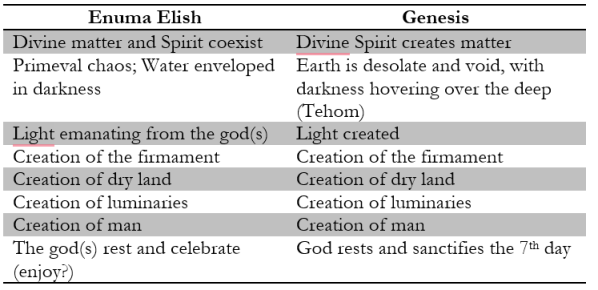
The original creation story is best represented by the Genesis text while a version that is full of filler events is found in Enuma Elish. In the Ancient Near East, stories grew as elements were added; they did not shrink into skeletal form. We should understand Enuma Elish reflecting a creation order that God had previously revealed, and Genesis as revealing the same revelation as God told it again to Moses.
Rest
When we compare the ideas of rest between the two stories, we see significant differences.
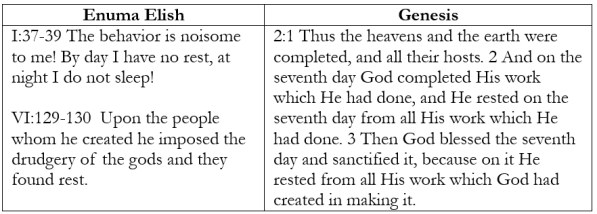
Rest in Enuma Elish is lost at the beginning of the story and is regained once Marduk has finished establishing the universe and assigning the hard work of the gods to mankind. The gods in Enuma Elish ultimately find their rest through the creation of a slave race and passing off their work to them.
The daytime rest that the gods want to have during their waking hours is best understood as an enjoyable productive life of ruling over their respective domains without doing hard work. When Ea rests in this story, he does so in the sanctuary of destinies where the future is determined–his rest is one that involves ruling over creation. God in Genesis rests as well, but we learn from Jesus that God’s rest doesn’t involve inactivity (John 5:17). We should understand God as ceasing from creation and entering into a state of rest that involves ruling over creation.
Purpose of Humanity
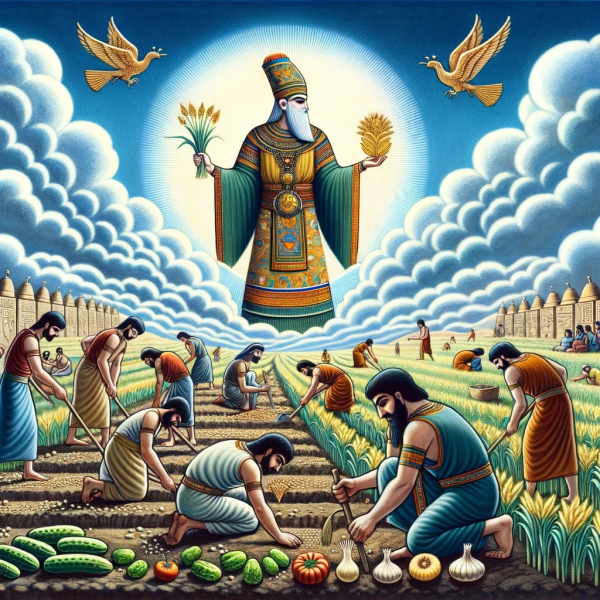
The purpose of humanity is entirely different in both stories.
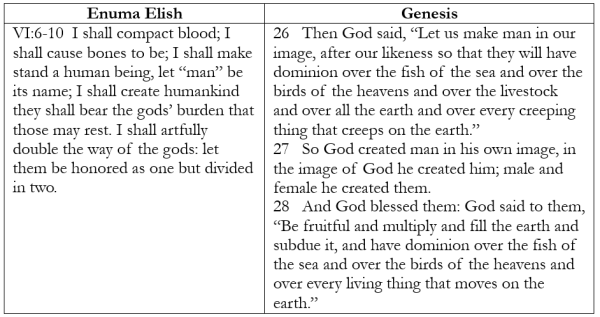
Man is made in God’s image and likeness so that he will exercise dominion over the world as his representatives. Essentially, man is made to display the glory of God. Just as God made the world unformed and then made order out of disorder, so man is to subdue a wild world and turn it into an orderly world for the glory of God. By contrast, in Enuma Elish, humans are slaves made from the blood of an evil deity whose sole purpose is to do hard work so that the gods don’t have to; the gods eat and rest because man does their work and gives them offerings.
Side note:
Since it was humanity’s job to subdue the world, gaining dominion over all things (Gen 1:28), Christ is said to reign in order to subdue all things (1 Cor 15:25), as God has destined him to do (1 Cor 15:27), so that he can give the world to the Father (1 Cor 15:24). So, Christ completes the work that humanity was originally assigned to complete. There is no work left to be done. The New Heavens and the New Earth will be one giant garden (which is one giant temple) in which the job is to “work it and keep it,” but there is no duty to subjugate the world and gain dominion over all things.
Purpose of the universe
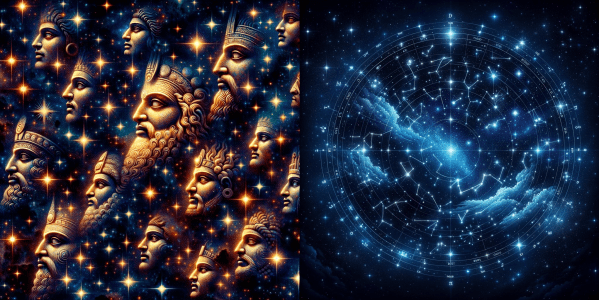
The purpose of the universe in Enuma Elish is to benefit the gods. Mankind was made to make the lives of the gods easier. By contrast, everything in God’s creation is stated to be beneficial (the Hebrew term for “good” also means “beneficial”). We understand that it is man that is the recipient of the benefit because of two factors: (i) God does not benefit from the things that he calls beneficial; (ii) the stars are made to be calendrical signs, which cannot be for God’s benefit or for the benefit of the animals; only humans use the stars for a calendar.
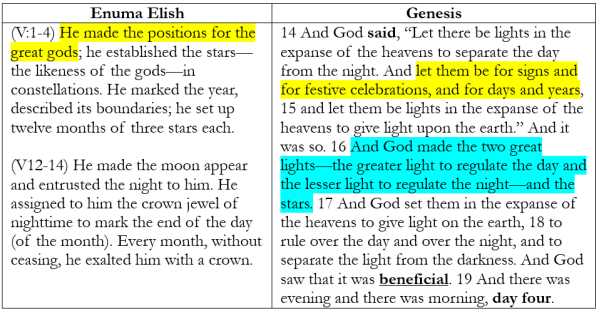
Moses carefully describes the sun and moon as the greater and lesser lights in order to make clear that neither are divine begins. In Enuma Elish, the heavenly bodies are the resting places of divine beings. In Genesis, the heavenly bodies are man’s calendar and light source. They don’t rule over man and command him to work, they exist to benefit mankind.
In one sense, the purpose of the universe involves the benefit of man; everything was made to man’s benefit. But in another sense, man being made in God’s image indicates man’s purpose. So, the universe’s purpose is tied up with the goal of displaying God’s glory in his image bearers. Or, as the New Testament puts it, God does everything for his own glory (Ps 106:7-8; Isa 48:9-11; Eph 1:4-6; etc.), including the creation of the universe.
The Creation of Man
The narrative sections where God creates man and where Ea creates Marduk both show significant and important parallels. However, these are worthy of their own post and will be discussed there.
Takeaways from Enuma Elish
By understanding Enuma Elish to be in the background as a document that Moses is intentionally correcting, we perceive a number of facts.
First, we see that the ancient peoples had no problem whatsoever with the idea that light can exist prior to luminaries (sun, moon, and stars). So, when someone argues that we can’t understand God as having created light before creating the sun, moon, or stars, we know that such a person is imposing limitations on God that no one in the ancient world considered to be true. Moses’s writings support the notion that God can create light without creating light sources and his audience would have already believed this idea.
Second, the lowly position of mankind that is presented in Enuma Elish is clarified as actually being an honored position, and man is shown to NOT have been created from an evil deity. Presumably, human nature was seen to be evil by design based on the fact that man was made out of an evil deity.
Third, the sun, moon, and stars are denied as being deities. Genesis corrects the idea that the gods are in the sky looking down upon mankind by presenting them as mere light sources and calendrical tools. In fact, we see that the statements “God saw that it was good” are about God seeing that things are beneficial for mankind, his beloved children.
Fourth, divine rest is not the result of mankind slaving away on God’s behalf. God is never presented in the Bible as needing man to provide for him. And so, unlike the Mesopotamian deities, God cannot be manipulated or bribed with sacrifices and offerings.
And finally, we see that God is entirely in control of everything; there is no battle for him to fight or danger for him to overcome. We saw that Marduk had a list of monsters to beat up before he could create the world; God has only to speak. He turns disorder into beneficial order in order to set an example for man, not because he needs to do things this way.
 VersesVersusVanity
Leave a comment