
In this post:
Egypt
•Ramesside Stela
•Hymn to Ptah
Mesopotamia
•Atra-Hasis
•Creation of Dry Land
•The Creation of Living Creatures
•Enki and Ninhursag
How should we understand these parallels?
•Empirical Support
What was known prior to Genesis being written down? Did Noah know about the creation of the world? Did Abraham know about Adam and Eve? How could Melchizedek have known about the Most High God (El Shaddai)? Why doesn’t Moses explain that God is uncreated, sovereign, and all powerful?
In this post we will look at texts that predate Moses that give us insight into what was known about God prior to the penning of Genesis 1-3. This brief exploration into Ancient Near Eastern literature will give use the foundation we need the answer these questions. We can’t explore every text, but we will look at some of the most significant ones.
Egypt
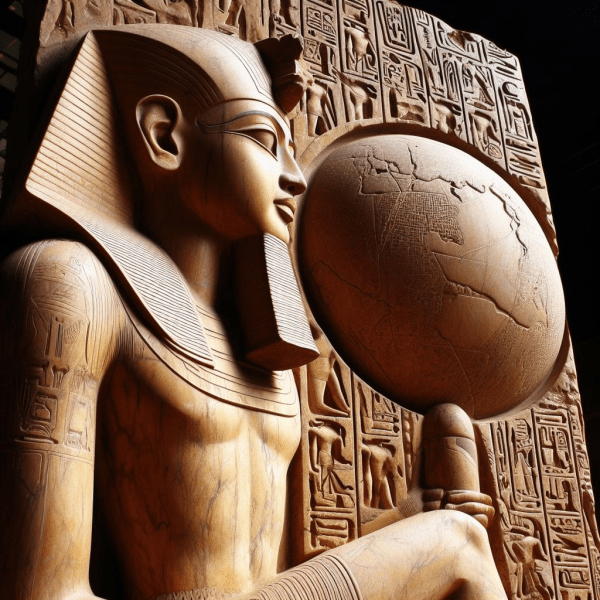
Since the Israelites were coming out from Egypt, it is helpful to see what sorts of beliefs the Egyptians would have been familiar with. Let’s look at a description of the Egyptian creator deity Ptah on a stela of Ramses that dates between 1539-1292 BC:
From a Ramesside Stela (1539-1292 BC)
Yours truly is worshipping your perfection, great Ptah, South of His Wall, Ta-tenen in the midst of the Walls.’
Noble god of the first occasion, who built people and gave birth to the gods, original one who made it possible for all to live; in whose heart it was spoken, who saw them evolve, who foretold what was not and thought of what is.
There is nothing that has evolved without him, he whose evolution is their evolution’ in the course of each day, anterior to what he has determined. You have set the world to its laws as you made it, and the Black Land is fixed under your command, like the first occasion.
We see that the creator deity was considered to be alone prior to the creation of other beings that are called ‘gods.’ Since the Old Testament refers to angels as gods (Ps 8:5; Heb 2:7), it would agree with the idea that God existed alone prior to the creation of other beings called gods.
We can also see that the creator god was thought to be sovereign; he fortells in advance what will be and the things that exist are what he imagined beforehand. Again, the Bible is in agreement that God knows the end from the beginning, and it is God’s plans that play out in history (Isa 46:10). Along these lines of thought, we also see that the creator deity is thought to have established the laws that government the world, which once again is something Bible agrees with.
And finally, the statement “there is nothing that has evolved without him” sounds a lot like John 1:2. It isn’t that John would have been familiar with this stela inscription, but rather that John’s understanding of what happened back in Genesis 1 corresponds to what the Egyptians thought must have been true about the creator deity.
John 1:3 All things were made through him, and without him was not any thing made.
This portion of a hymn to Ptah shows that the Egyptians believed that the creator God was self-existent; he comes from himself. This text is, admittedly, later than Moses. However, there is every reason to believe that it reflects Egyptian theology that had already been established for a very long time.
From the Berlin “Hymn to Ptah” (1129-1111 BC)
Worshipping Ptah, father of the [god]s, Ta-tenen, eldest of the originals, [at] daybreak.’
Greetings, Ptah, father of the gods, Ta-tenen, eldest of the originals, who begot himself by himself, without any evolving having evolved; who crafted the world in the design of his heart; evolution of his evolutions model who gave birth to all that is, begetter who created what exists.
We can see from the Egyptian texts that they believed in an original monotheism where a deity existed in-and-of-himself and the world came from himself, not from pre-existing matter. However, there is no story arc comparable to what is seen in Genesis 1-3. The Egyptian material was likely in the background thinking of Moses and the Israelites, which explains why Moses didn’t feel he needed to make such statements; he and his audience already assumed these things to be true, and Moses’ conversations with YHWH confirmed those beliefs (Exod 33:9-11). We see that the Israelites were intimately familiar with Egyptian religion (Ezek 20:7-8).
Ezekiel 20:7–8 And I said to them, ‘Cast away the detestable things your eyes feast on, every one of you, and do not defile yourselves with the idols of Egypt; I am the LORD your God.’ But they rebelled against me and were not willing to listen to me. None of them cast away the detestable things their eyes feasted on, nor did they forsake the idols of Egypt.
Mesopotamia
Abraham came from Mesopotamia where the international trade language was Akkadian, the Mesopotamian language that most of the texts we’re about to look at were written in. Even in Egypt, archaeologists have found scribal training schools with myths from Mesopotamia, which means that they were part of the curriculum in training scribes to communicate in the international language. So, Israelites who took part in international trade would have learned of these myths, and they likely had some of them passed down through their family.
The texts from Mesopotamia show the greatest amount of overlap with Genesis 1-3 in their literary form, the order of events, and topics discussed. Let’s look at some of the most significant parallels.
Atra-Hasis
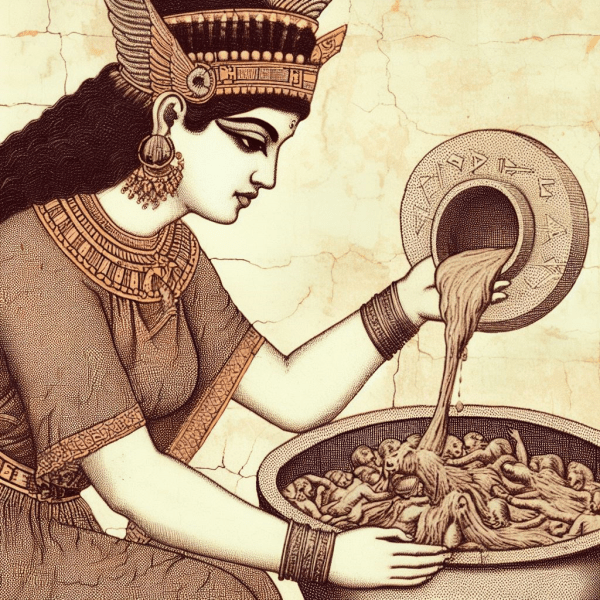
Dating to around 1800 BC, this text predates Moses and likely reflects beliefs that Abraham would have shared.
Belet-ili, the midwife], is present.
Let her create, then, a human, a man,
Let him bear the yoke, the task of Enlil
Let him bear the yoke, the task of Enlil
Let man assume the drudgery of god …”
Belet-ili, the midwife], is present,
Let the midwife create a human being,
Let man assume the drudgery of god.”
They summoned and asked the goddess,
The midwife of the gods, wise Mami:
“Will you be the birth goddess, creatress of mankind?
(195) Create a human being that he bear the yoke,
Let him bear the yoke, the task of Enlil,
Let man assume the drudgery of god.”
They slaughtered Aw-ilu, who had the inspiration, in their assembly.
(225) Nintu mixed clay with his flesh and blood. <That same god and man were thoroughly mixed in the clay. >
For the rest [of time they would hear the drum], from the flesh of the god the spirit remained. It would make the living know its sign, (230) Lest he be allowed to be forgotten, [the] spirit remained.
After she had mixed that clay, she summoned the Anunna, the great gods. The Igigi, the great gods, spat upon the clay. (235) Mami made ready to speak, and said to the great gods: “You ordered me the task and I have completed (it)! You have slaughtered the god, along with his inspiration. (240) I have done away with your heavy forced labor, I have imposed your drudgery on man. You have bestowed clamor upon mankind. I have released the yoke, I have [made] restoration.”
They heard this speech of hers, (245) they ran, free of care, and kissed her feet, (saying): “Formerly [we used to call] you Mami, Now let your name be “Mistress-of-All-the Gods (Belet-kala-ili)”
In Atra-Hasis, the gods are viewed as needing to eat and working the land in order to provide food. They despise the work and demand that a creature be made to do their work for them. Man was made from the blood of a deity named “Aw-ilu” (“god speaks”) whose name is nearly identical to the Akkadian word for man (‘awilu’). So, man is derived from a deity for the purpose of slave labor; there is no dignity for mankind and no blessing. The drudgery that the gods hate is the drudgery of man.
In Genesis, by contrast, God works the world into a livable place and creates an irrigated garden for man to enjoy. Man is assigned the task of maintaining the garden, but there is no hint that this is painful drudgery. Only after the fall do we see the work as involving negative aspects. God is never spoken of as needing food nor needing man to provide for him.
Moses’ creation story sets up God as being generous and needing nothing. Man’s relationship with God is not one of necessity on God’s side like the relationship is in the Atra-Hasis myth. Furthermore, the divine blood that is used to create man’s spirit in Atra-Hasis implies that some part of man is inherently divine. By contrast, the creation of man involves no intimate part of God and thus does not imply any inherent divinity within man.
Creation of Dry Land

The story of the creation of dry land includes two fascinating ideas, one supported by Genesis and the other by the book of Psalms.
1. The holy house, the house of the gods, in the holy place had not yet been made;
2. No reed had sprung up, no tree had been created.
3. No brick had been laid, no building had been set up;
4. No house had been erected, no city had been built;
5. No city had been made, .no creature had been created.
6. Nippur had not been made, E-kur had not been built;
7. Erech had not been created, E-ana had not been built;
8. The Deep had not been created, Eridu had not been built;
9. Of the holy house, the house of the gods, the habitation had not been made.
10. All lands were sea.
11. At that time there was a movement in the sea;
12 . Then was Eridu made, and E-sagil was built,
13. E-sagil, where in the midst of the Deep the god Lugal-dul-azaga 1 dwelleth;
14. The city of Babylon was built, and E-sagil was finished.
15. The gods, the Anunnaki, he 2 created at one time;
16. The holy city, the dwelling, of their hearts’ desire, they proclaimed supreme.
17. Marduk laid a reed upon the face of the waters,
18. He formed dust and poured it out beside the reed. 19. That he might cause the gods to dwell in the habitation of their hearts’ desire,
We see that in this creation story that the world began as entirely being made of water and then Marduk creates land on top of water. Genesis supports the idea of the world being made of water, and although Genesis does not support the idea that the land was found on top of the water. Instead, we see a very vague description of the formation of land that tells us very little about how it was formed apart from it being the result of God’s command.
In contrast with Genesis, Psalm 24 does appear to communicate the idea that the land was formed on top of the water. This Psalm, however, may be intentionally polemical and not intended to communicate the actual means by which God created land.
Psalm 24:1 The earth is Yahweh’s, as well as its fullness, the world, and those who dwell in it. 2 For He has founded it upon the seas and established it upon the rivers.
The Creation of Living Creatures
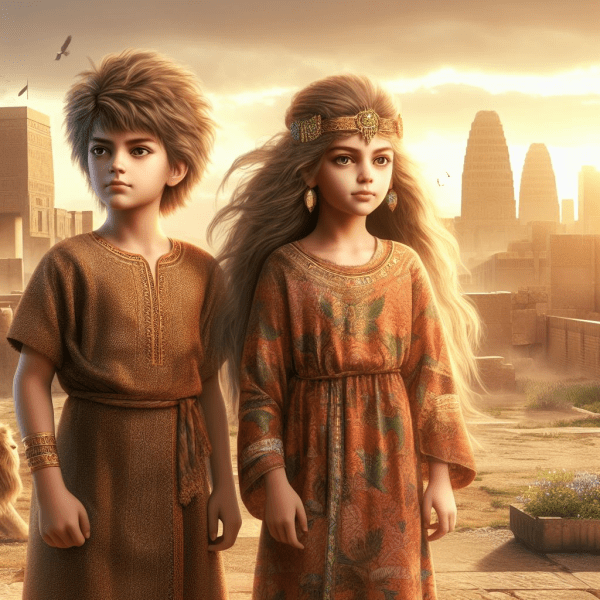
Unfortunately, most of this tablet was destroyed beyond recognition, and only a small fascinating portion remained to be translated.
1. When the gods in their assembly had made [the world],
2. And had created the heavens, and had formed [the earth],
3. And had brought living creatures into being […],
4. And [had fashioned] the cattle of the field, and the beasts of the field, and the creatures [of the city],–
5. After [they had …] unto the living creatures […],
6. [And between the beasts] of the field and the creatures of the city had divided […]
7. [And had …] all creatures, the whole of creation |…],
8. [And had …], which in the whole of my family […],
9. [Then did] Nin-igi-azag [fashion] two small servant-[children…]. 10. [Among] all the beasts he made [their form] glorious
The most striking similarities are found in the phrasing of the creation of heaven, earth and also the creation of the cattle and beasts. Less clear is whether the two small but glorious beings should be understood in relationship to the two humans who are made in God’s image (presupposed to be glorious) and whether their glorious nature was meant to indicate that they had a right to rule over the lesser creatures (as was a common notion at the time). Either way, two glorious servants are put upon the earth and that does parallel God creating Adam and Eve and giving them the work of serving in the garden.
Enki and Ninhursag
The lengthy store of Enki and Ninhursag contains a portion that appears to recall a time and a place when there was neither sickness, nor aging, nor human death, nor animal death.
Below is a portion of the lengthy story of Enki and Ninhursag
The land Dilmun is pure.
That place is clean, that place is bright.
In Dilmun the raven utters no cries,
The ittidu-bird” utters not the cry of the ittidu-bird,
The lion kills not,
The wolf snatches not the lamb,
Unknown is the kid-devouring wild dog,
Unknown is the grain-devouring .. . ,
[Unknown]* is the .. . widow,
The bird on high . .. s not its…, (20)
The dove droops not the head,
The sick-eyed says not “I am sick-eyed,”
The sick-headed (says) not “I am sick-headed,”
Dilman’s old woman (says) not “I am an old woman,”
Its old man (says) not “I am an old man,”
Unbathed is the maid, no sparkling water is poured in the city,
Who crosses the river utters no…
The wailing priest walks not round about him, The singer utters no wail, by the side of the city he (utters) no lament
While Genesis does not go out of its way to similarly deny that such things were taking place prior to the Fall, the narrative of Genesis indicates that prior to the Fall that the world was not filled with suffering and death. Consequently, this story contains a similar idea that once upon a time there was a place without death and suffering.
Enuma Elish
The number of parallels between Enuma Elish and Genesis 1 is staggering. Another post will be dedicated to exploring these parallels.
How should we understand these parallels?
If we take the biblical account seriously then we believe that there was once a time when all of humanity lived together and had a common history that involved the events described in Genesis 1-11. What would happen if humanity was divided into groups and scattered across the world as we see in the story of the Tower of Babel? We would see similar stories across many nations. As time progressed, we’d see the stories become increasingly warped as historical memory became hazy and as stories were intentionally changed for political or personal reasons. The end result would be the oldest stories most closely resembling the contents of Genesis and the most recent versions being the most different due to all the changes over thousands of years.
Moses, a man who got his information from God, can be understood as correcting the falsehoods that had crept in (Exod 33:9-11). He does this by recounting the most important details that the Israelites need to know and very clearly denying the theological corruptions that are found in the texts from the Ancient Near Eastern nations. For example, Moses calls the sun “the greater light” and he labels the moon the “lesser light.” He completely avoids the Hebrew words for sun and moon because he knows that both of these words are used as names for gods, and he wants to make sure that his audience understands that the sun and moon are not divine beings.
Exod 33:9–11 When Moses entered the tent, the pillar of cloud would descend and stand at the entrance of the tent, and the LORD would speak with Moses. And when all the people saw the pillar of cloud standing at the entrance of the tent, all the people would rise up and worship, each at his tent door. Thus the LORD used to speak to Moses face to face, as a man speaks to his friend. When Moses turned again into the camp, his assistant Joshua the son of Nun, a young man, would not depart from the tent. (ESV)
For some, this proposal might seem like wishful thinking on behalf of Christians who don’t want to come to grips with the fact that Genesis is just a patchwork of silly myths. However, the empirical facts support this proposal.
Empirical Support
Wilhelm Schmidt in his work The Origin and Growth of Religion showed that the most isolated and distant primitive cultures that have had the least amount of contact with other cultures tend to contain, at minimum, a corrupted version of Genesis 1-3. Those who possess more tend to have the contents up until Genesis 11 in distorted forms. This book is summarized, updated, and supported by In The Beginning God by Winfried Corduan. The most rational explanation for the similarities amongst the most isolated and disparate peoples is that once humanity had a common history, something caused humanity to split into people groups, and remnants of that shared history remain in the myths of these people groups.
So, the most ancient beliefs are closest to the contents of Genesis 1-11 and the beliefs of the most isolated people groups, which reflect the ancient beliefs, are also the closest to Genesis 1-11.
Up Next: We will look at the significant parallels between Enuma Elish and Genesis 1.
 VersesVersusVanity
Leave a comment