
In this post:
What is a Covenant?
Comparison between Contracts and Covenants
Covenant Example from the days of Moses
Covenant Takeaways
What is a Covenant?
The backbone of scripture that organizes and gives sense to the content of the Bible is the series of covenants that God made with man. Every verse of scripture is to be interpreted in light of the covenant that was in place at the time when it was written. But what exactly is a covenant? Are covenants essentially like contracts?
Covenant Defined:
A covenant contains the stipulations of a relationship between two parties involving permanent and serious commitments to faithfully loyal love, obedience, and trust.
Comparison between Contracts and Covenants
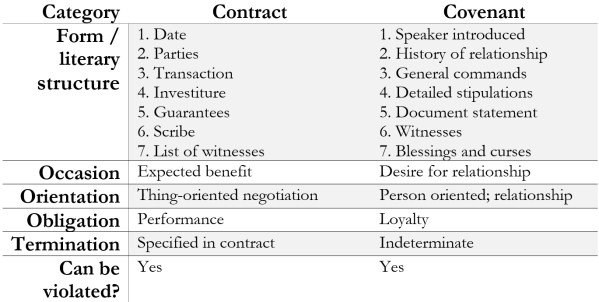
If we compare ancient covenants to ancient contracts we see a number of important differences that prevent us from seeing the two as being the same thing. Consider the chart below.
Literary Form
Looking at the organizational difference, we see that covenants have an obvious relationship-focus based on the fact that they detail the history of the relationship leading up to the formalization of the covenant. Have you ever signed a contract that first and foremost was about your relationship with the other party? Neither in the past nor in the present do contracts concern relationships in such a way.
Occasion
Contracts are made when people desire certain benefits, whether products or services. Whether there is a good relationship between the contract members is irrelevant so long as stated exchange happens successfully. Covenants, by contrast, focus upon the relationship between the party members. There are benefits to be had by both sides to be sure, but loyalty and faithfulness are not dispensable in a covenant.
Orientation
Contracts are goods and services oriented while covenants are relationship oriented. If we look at covenants between unequal parties (often called suzerain-vassal treaties), the greater king is referred to as the father and the lesser king is referred to as the son. Consider this letter from the lesser king of Ḫatti to the greater king of Egypt:
El-Amarna Letter 44
Speak to the lord, king of the land of the city of Egypt, my father; thus Zidan, the son of the king, your son. May all be well with the lord, my father. With a previous caravan of any of your envoys, they came to the land of the city of Ḫatti, and when they returned to you, then it was I who sent greeting gift to you, my father, and I had a shipment sent to you. Now, as for your envoys, I am expediting them on their way from the land of the city of Ḫatti to you and it is I who am sending with your own envoys, my envoys and a shipment of sixteen men have I had brought to you as a greeting gift. And I desire gold, so, my father, send gold and whatever my lord, my father, you desire, write to me and I will have it brought to you.
When letters were sent between covenant members that were of equal status, the language of ‘brother’ is used. We see this in the letter from the king of Egypt to the king of Babylon (Karaduniyash). The correspondence involves not only political matters but also evidences concern for the personal well-being of both parties.
El-Amarna Letter 1
Speak to Kadashman-Enlil, king of the land of Karaduniash, my brother! Thus Nibmuʿareʿa, the great king, king of the land of Egypt, your brother: With me all is well; may all be well with you. With your house, with your wives, with your sons, with your senior officials, with your horses and with your chariotry, (and) in the midst of your territories, may all be exceedingly well. With me all is well, with my house, my wives, with my sons, with my senior officials, my horses, my chariotry (and) ‹my› troops, it is all very well and within my territories it is very well.
Obligation
The main obligation of the contract is the fulfillment of the terms. By contrast, the main obligation of a covenant is loyalty and faithfulness. Any disgruntled employee can tell you about how he technically fulfills his job contract but has no loyalty to his company. Meanwhile, an employee who loves his employer will not only fulfill the details of his contract but will go above and beyond in many ways that the disgruntled employee would never consider doing. Loyalty and faithfulness involve doing that which improves the relationship, unlike contract fulfillment which focuses upon doing the bare minimum to fulfill the contract.
Covenants in the ancient world between a king and his people are filled with loyalty language. Consider this one section of a very long covenant between the king of Assyria and his subjects:
§5 You shall protect Assurbanipal, the great crown prince designate, whom Esarhaddon, king of Assyria, appointed for you and ordered for you, and concerning whom he confirmed and established an adé-oath with you. You shall not do him wrong. You shall not raise your hands for evil against him. ‘You shall not undertake machinations, a revolt, (or) anything malicious and harmful. You shall not remove him from the kingship of Assyria. You shall not help (one) of his brothers, older or younger, take the throne of Assyria in his place. You shall not place a different king (or) different lord over yourselves. You shall not swear an oath to a different king (or) a different lord.
Termination
Contracts are terminated when the stipulations are not met. By contrast, since covenants are intended for the continued growth of a relationship, they often permit repentance and relational repair. God exemplifies this in his patience with sinful Israel and his delay in handing down the death penalty to Adam and Eve; they were given time to turn in repentance and find forgiveness through the means that God would provide.
Covenant Example from the days of Moses
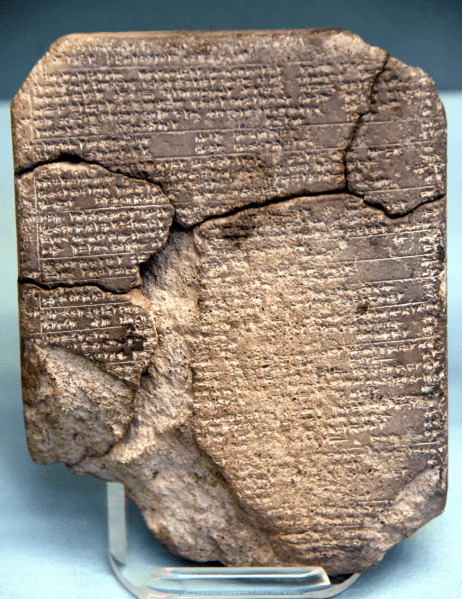
The following provides the text of the majority of the covenant between Mursili II of Hatti and Tuppi-tesh-shup of Amurru (14th c. BC). The literary outline is very similar to that of Deuteronomy, which is understandable if God is to be comprehended as using a literary organization that would easily be perceived in the days of Moses.
Covenant between Mursili II of Hatti and Tuppi-tesh-shup of Amurru (14th c. BC)
Speaker
Taken from Context of Scripture Vol 2
Thus says My Majesty, Mursili, Great King, king of Hatti, hero, beloved of the Stormgod, son of Suppiluliuma, Great King, king of Hatti, hero.
Historical Relationship
Duppi-Tesub! Your grandfather Azira submitted to my father. When it came about that the kings of Nuhhasse and the king of Kinza became hostile, Azira did not become hostile. When my father fought his enemies, Azira likewise fought them. Just as Azira protected my father, my father protected Azira together with his land. He did not seek to harm him in any way, and Azira did not anger my father in any way. He kept delivering to him the 300 shekels of refined gold of first-class quality that had been decreed. My father died and I sat on the throne of my father. And just as Azira had been in the time of my father, so he was in my time. When it came about that the kings of Nuhhasse and the king of Kinza became again hostile in my time, Azira, your grandfather, and DU-Tesub, your father, did not join them. They supported only me in (my) overlordship. And when Azira became old and was no longer able to go on military campaign,” just as Azira went to battle with troops and chariots, DU-Tesub likewise went to battle with the troops and the chariots of the land of Amurru. And I, My Majesty, destroyed those enemies. … Azira, your father, to my father … came … I gave to DU-Tesub …’ When your father died, according to the request of your father I did not reject you. Since your father during (his) lifetime^!) had often mentioned your name before me, therefore I took care of you. You fell ill and became sick, but even though you were sick, I, My Majesty, still installed you in the position of your father and for you I made …, your brothers, and the land of Amurru swore allegiance to you.
General Commands
When I, My Majesty, took care of you according to the word of your father, and installed you in the place of your father, behold, I have made you swear an oath to the king of Hatti, I have made you swear an oath to the king of Hatti, to the land of Hatti, and to my sons and my grandsons.* Keep the oath of the king and the hand of the king, and I, My Majesty, will protect you, Duppi-Tesub. When you shall take your wife and if you produce a son, he shall later be king in the land of Amurru. And as I, My Majesty, protect you, I will likewise protect your son. You, Duppi-Tesub, protect in the future the king of Hatti, the land of Hatti, my sons, and my grandsons. The tribute which was imposed upon your grandfather and upon your father — they delivered 300 shekels of refined gold of first-class quality by the weights of the land of Hatti — you shall deliver likewise. Do not turn your eyes towards another (land)! Your ancestors paid tribute to Egypt, but you should not pay tribute to Egypt because Egypt has become an enemy … [four lines lost]
Detailed Stipulations
If the king of Egypt will become My Majesty’s friend, you too should be his friend, and you may keep sending your messenger to Egypt. But if you commit treachery, and while the king of Egypt is hostile to My Majesty you secretly send your messenger to him and you become hostile to the king of Hatti, and you cast off the hand of the king of Hatti becoming (a subject) of the king of Egypt, thereby you, Duppi-Tesub, will break the oath…[goes on for many lines]
The Divine Witnesses
Behold, let the thousand gods stand by for this oath! Let them observe and listen! (D iii.’-ir) Sun-god of Heaven, Sun-goddess of Arinna, Storm-god of Heaven, Storm-god of Hatti, Seri (and) Huri, Mount Nanni and Mount Hazzi, Storm-god of the Gate-house, Storm-god of the Army, Storm-god of Halab, Storm-god of Zippalanda, Storm-god of Nerikka… [goes on to list dozens more gods]
Curses and Blessings
All the words of the treaty and the oath which are written on this tablet — if Duppi-Tesub does not keep these words of the treaty and of the oath, then let these oath gods destroy Duppi-Tesub together with his head, his wife, his son, his grandson, his house, his city, his land and together with his possessions. (A iv.-) But if Duppi-Tesub observes these words of the treaty and of the oath which are written on this tablet, let these oath gods protect Duppi-Tesub together with his head, his wife, his son, his grandson, his city, his land, your(!) house, your(!) subjects and together with his possessions!
Colophon
First tablet of Duppi-Tdub’s treaty. Complete.
We see this relationship emphasis clearly in Jonathan’s covenant with David. Both expect loyalty and faithfulness from each other and formalize a covenant between each other in order to secure that loyalty and faithfulness.
1 Sam 18:1-3 Now it happened when he had finished speaking to Saul, that the soul of Jonathan was knit to the soul of David, and Jonathan loved him as his own soul. And Saul took him that day and did not let him return to his father’s house. Then Jonathan cut a covenant with David because he loved him as his own soul.
1 Sam 20:8-16 “Therefore show lovingkindness to your servant, for you have brought your servant into a covenant of Yahweh with you. But if there is iniquity in me, put me to death yourself; for why then should you bring me to your father?” And Jonathan said, “Far be it from you! For if I should indeed come to know that evil has been decided by my father to come upon you, then would I not tell you about it?” Then David said to Jonathan, “Who will tell me if your father answers you harshly?” And Jonathan said to David, “Come, and let us go out into the field.” So both of them went out to the field. Then Jonathan said to David, “Yahweh, the God of Israel, be witness! When I have examined my father about this time tomorrow, or the third day, behold, if there is good feeling toward David, shall I not then send to you and reveal it in your ear? “If it please my father to do you harm, may Yahweh do so to Jonathan and more also, if I do not reveal it in your ear and send you away, that you may go in peace. And may Yahweh be with you as He has been with my father. And if I am still alive, will you not show me the lovingkindness of Yahweh, that I may not die? You shall not cut off your lovingkindness from my house forever, not even when Yahweh cuts off every one of the enemies of David from the face of the earth.” So Jonathan cut a covenant with the house of David.
We also see this in God’s covenant with Israel where God requires love and declares himself to be a faithful covenant member.
Deut 6:5 You shall love Yahweh your God with all your heart and with all your soul and with all your might.
Exod 34:6 Then Yahweh passed by in front of him and called out, “Yahweh, Yahweh God, compassionate and gracious, slow to anger, and abounding in lovingkindness and truth.”
Covenant Takeaways
What are the major takeaways from what we’ve discussed here? On a purely factual level, we can take the following away:
- Covenants are clearly distinct from contracts and should not be understood in the way that we understand contracts in our modern day; covenants are relationship-focused while contracts are not.
- God used the terminologies and literary styles that people were accustomed to in their day. We, living thousands of years in the future, need to take the time to understand the nuances of these literary styles.
On a more devotional level:
- God is entirely faithful and loyal in his covenant relationships. He not only keeps the specific terms he sets out for himself, but he goes above and beyond to show love and faithful loyalty.
- God is interested in a relationship with you; he isn’t merely interested in you following rules. Because he is interested in having a relationship with you, he has provided a way for you to be forgiven for your covenant violations through Jesus Christ.
We must never approach God as if he were merely a lawmaker whose only concern is that everyone follows his rules. The terms of his covenants are the foundation of a relationship that is meant to grow and flourish for all of eternity.
 VersesVersusVanity
Leave a comment