

In this post:
1) Is Josheb-basshebeth the Tahchemonite the same person as Jashobeam the son of a Hachmonite?
● Man of Baal = Man of Shame = He sits in the seat / He sits with the people
● Son of a Hachmonite = Tahchemonite
● Son of a Hachmonite or the Son of Zabdiel?
2) Was He Called “Adino the Eznite,” or did he “lift up his spear”?
● Did he kill 800 or 300 people?
3) Corrected text
4) How could he kill so many at one time?!
5) Conclusion
Introduction
In the two lists of David’s mighty men, we encounter an imposing warrior who appears to have slaughtered either 800 men or 300 men. Not only do we see a difference in how many people he killed, but we also see that his name and clan are oddly different.
2 Sam 23:8 Josheb-basshebeth a Tahchemonite, chief of the captains, he (was called) Adino the Eznite because (of) eight hundred slain at one time.
1 Chron 11:11 These constitute the list of the mighty men whom David had: Jashobeam, the son of a Hachmonite, the chief of the thirty; he lifted up his spear against three hundred slain at one time.
Some apologists try to argue that we’re dealing with two different people here and so there is no contradiction, but the evidence does not line up to support this claim. We have a genuine problem here that needs to be dealt with. But first, we need to see why scholars agree that Josheb-bashhebeth and Jashobeam are the same individual.
Is Josheb-basshebeth the Tahchemonite the same person as Jashobeam the son of a Hachmonite?
Both the name of this person and the family he comes from appear to be different. You might even think that there were two different people who each were the chief of David’s thirty captains at different times. However, this is not the case; they are the same person.
Man of Baal = Man of Shame = He sits in the seat / He sits with the people
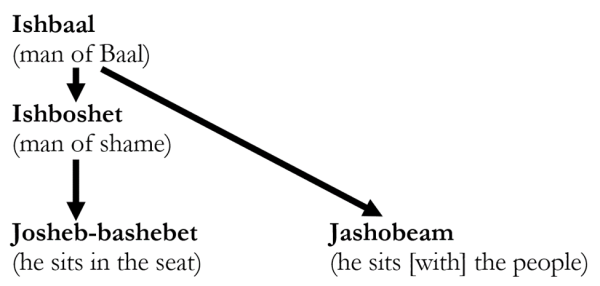
At first glance, it might seem to you like Josheb-basshebet and Jashobeam are such different names that these may be entirely different people. However, there is an interesting story that caused one person’s name to end up being very different in these two different texts.
This man’s name was actually Ishbaal (“man of Baal”). He came from an Israelite family that descended from Perez (1 Chron 27:2-3) who had abandoned YHWH (as we can tell from the fact that they named their son after Baal). When 2 Samuel was written, the scribes were so offended by the name Ishbaal (“man of Baal”) that they changed his name to Ishboshet (“man of shame”), which is also what they did with Saul’s son Ishbaal (which they renamed Ishboshet). But when Chronicles was written, the scribes didn’t have the same sensitivities, and they accurately recorded his name as Ishbaal. Sometime around 200 BC, Samuel and Chronicles were translated into Greek, where we see the name Ishbaal in the Greek version of 1 Chron 11:11 and we see the name Ishboshet in the Greek version of 2 Sam 23:8.
Later scribes who were copying the Hebrew changed both of these names. Ishboshet (“man of shame”) was changed from that insulting name to what we see now: Josheb-bashebet (“he sits in the seat”). Some other scribes changed Ishbaal (“man of Baal”) in 1 Chron 11:11 to Jashobeam (“he sits (with) people” or “the people sit”). I’m not entirely sure what motivated these scribes to make his name have something to do with sitting. Perhaps it was the fact that the insulting version of his name Ishboshet (“man of shame”) is an anagram for Ishshobet (“a seated man”).
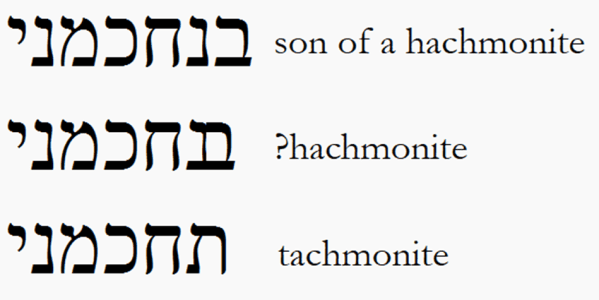
Son of a Hachmonite = Tahchemonite
Although “Tahchemonite” and “son of a Hachmonite” look quite different in English, the distinction in Hebrew was very small. If a scribe accidentally moved two letters too close together, they could form a shape that was ambiguous as to whether it said “ta” or “son of.” Or, if the scroll had been damaged or the writing faded or smudged, it would be easy to confuse the two.
Son of a Hachmonite or the Son of Zabdiel?
Ishbaal was the son of Zabdiel (1 Chron 27:2) from the family of Perez. So, why does the text say that he was the son of a Hachomite? Is this a contradiction? The only other time we see “Hachmonite” in the Bible is 1 Chronicles 27:32, where David’s wise men are listed.
1 Chron 27:32-34 Also Jonathan, David’s uncle, was a counselor, a man of understanding, and a scribe; and Jehiel the son of a hachmonite was with the king’s sons. Ahithophel was counselor to the king; and Hushai the Archite was the king’s friend. Jehoiada the son of Benaiah, and Abiathar succeeded Ahithophel; and Joab was the commander of the king’s army
The word “Hachmonite” (חכמני) comes from the word Hacham (חכם – “wise”). If we were to play the same sort of word game in English, we’d change the word “wise” into something like “wiseguy” or “wiseling.” What does it mean to be the son of a wiseguy? Well, it could mean that Zabdiel was a wise man who was called a wiseguy. It could also mean that Jahiel was a wiseguy himself; the way Biblical Hebrew communicates the idea of ‘membership in a group’ is through using “son of _____” language. For example, “on a very fertile hill” (Isa 5:1) is literally “on the peak of a son of fatness.” Hills and peaks of hills do not have children and are not literally fat; but the way to say that the peak of a hill is fertile ground is by saying that it is the son of fatness. Similarly, being the “son of a prophet” (1 Kings 20:35; 2 Kings 2:3) means that a person belongs to the class of prophets. So, it may be that saying that Jahiel is the son of a wiseguy is simply saying that Jahiel was himself a wiseguy. This last option is more likely, since literally being the son of someone who was known for being wise doesn’t mean much by itself; not all wise parents produce wise children (consider Solomon and his foolish son).
So, there is no contradiction here.
Was He Called “Adino the Eznite” or did he “lift up his spear”?
2 Sam 23:8 Josheb-basshebeth a Tahchemonite, chief of the captains, he (was called) Adino the Eznite because (of) eight hundred slain at one time.
1 Chron 11:11 These constitute the list of the mighty men whom David had: Jashobeam, the son of a Hachmonite, the chief of the thirty; he lifted up his spear against three hundred slain at one time.
In English, “he was called Adino the Eznite” and “he lifted up his spear” are impossible to confuse, no matter how badly someone might have smudged the ink before it dried. This is not the case in Hebrew. Many of the letters are identical, and those that aren’t identical are similar enough that a smudged page can make them hard to distinguish:
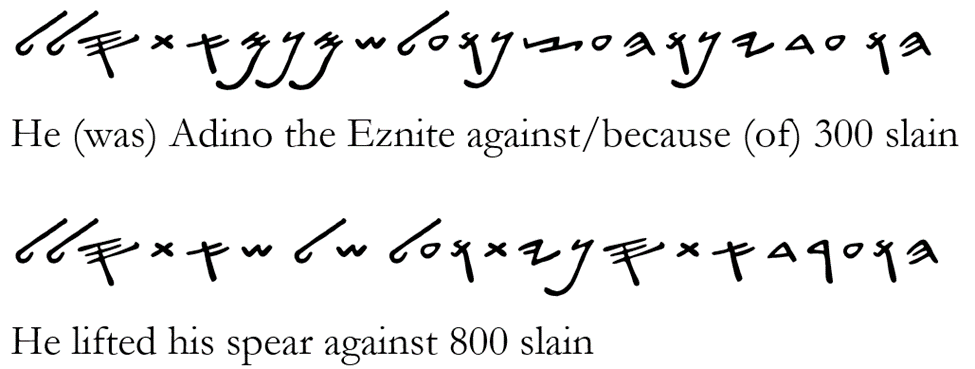
Anyone who has worked with ancient scrolls can tell you that it is a nightmare when you have a scroll whose ink has been smudged, whose paper has been torn, or whose writing has faded with time, especially if that scroll was written by a scribe with messy writing to begin with. It becomes a guessing game as to what was originally in that messy portion. Below are some images of texts of the Bible that have been damaged so that you can get a picture for what sort of difficulties arise when the text has suffered harm:
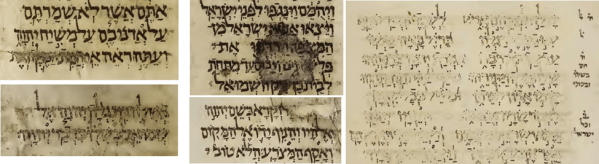
The number of problems we’re seeing in this small portion of text as we compare Samuel to Chronicles tells me that something bad happened to this part of the scroll and the next person who copied the Samuel scroll had to do a lot of guesswork to try to figure out what was originally there. Thankfully, God preserved for us what the scroll originally said in Chronicles!
Did he kill 800 or 300 people?
2 Sam 23:8 Josheb-basshebeth a Tahchemonite, chief of the captains, he (was called) Adino the Eznite because (of) eight hundred slain at one time.
1 Chron 11:11 These constitute the list of the mighty men whom David had: Jashobeam, the son of a Hachmonite, the chief of the thirty; he lifted up his spear against three hundred slain at one time.
The explanation we had in the previous section also explains the difference between 300 and 800; the text was damaged and the scribe who was writing out the next copy couldn’t clearly see what number had been written.
The Corrected Text
After all of the above discussion, we are able to correct the text of 2 Sam 23:8 to what it originally said:
2 Sam 23:8 [corrected] Ishbaal son of a hachmonite, chief of the captains, he lifted up his spear against three hundred, slain at one time.
We see that a man from an apostate Israelite family converted to Israel’s religion, followed David, was trained to be wise by a wiseguy, was chief of all the captains, and wielded his spear to kill three hundred people at one time. This was one impressive dude! But how could someone kill 300 people at one time?
He killed 300 people at one time?!

The term that is being translated as “time” is longer than a rega (“moment of time/blink of an eye”) but shorter than a day. This term paam (“time”) is often used to describe a footstep (Judges 5:28; Ps 17:5; 57:7) or a foot (Song 7:2) and is used when a person wants to express that a period of time is quite short (Isa 66:8). Ishbaal is impressive because of what he accomplished in a short period of time—this is not his lifetime accomplishment of slaughter. So, we’re forced to reckon with this man killing what looks like an enormous amount of people in a short amount time.
The text does not say that he killed 300 people by stabbing them individually until he had killed all 300. It just says that he wielded his spear against 300 and killed them. So, this could have been a case where he set a trap and the key to triggering the trap was a spear-throw. Alternatively, he could have stood at a narrow gate of a city and fought people one-on-one until he had dealt fatal wounds to either 300 individual people or three enemy battalions (each battalion being called a “hundred”). This type of strategy is seen in castles that were designed with narrow staircases so that one or two men could hold off a large invading force by forcing them to fight the defenders one at a time instead of being able to gang up against them.
Conclusion
So, we have seen that there are no true contradictions in these texts. Although there are major differences in how modern translators are translating them. We can fully recover what was lost from the damaged portion of the Samuel scroll (2 Sam 23:8) because 1 Chron 11:11 preserves the original text for us. There is also no problem with supposed genealogical differences (son of a hachmonite / son of Zabdiel) because “son of” language was used more broadly in the ancient world, including to indicate membership in a class/group. We’ve also seen that one man defeating 300 could make sense in at least a couple of different ways and is not an unrealistic claim.
 VersesVersusVanity
Leave a comment