
In this post:
The Problems:
1. Too many Ephraimites killed (42,000)!
2. Aphek’s Wall Kills 27,000?
3. Canaan’s Animals Too Numerous?
4. Archaeology of Canaan
Possible Solutions
1. Eleph means “Clan”
2. Exaggeration
3. Tens as Nuclear Families
Introduction
In our previous post, we debunked many of the common arguments against taking Israel’s population number literally in the book of Numbers. In this post we’ll be looking at the arguments that need to be taken seriously because they present severe challenges to a literal interpretation. Afterward, we will consider solutions to these problems.
Problems
First, we’ll look at number problems that are often lumped together with the huge census population in the book of Numbers. These problems are often taken as proof that the numbers in the Bible are fictional.
Too Many Ephraimites Killed
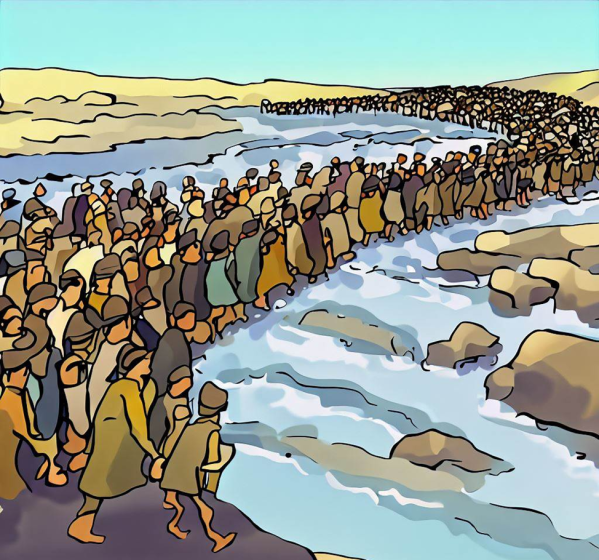
David Pouts claims that the number of Ephraimites killed are too many in Judges 12:6. In this story, the Gileadites captured the fords of the Jordan near Ephraim and required people who wanted to cross the fords to disclose whether they were from Ephraim. If they claimed to not be from Ephraim, the Gileadites would have them say “Shibboleth.” If they pronounced “Shibboleth” as “Sibboleth,” then they would kill them. The text claims that the Gileadites slaughtered 42,000 Ephraimites during this time.
Judges 12:5 And the Gileadites captured the fords of the Jordan opposite Ephraim. And it happened when any of the fugitives of Ephraim said, “Let me cross over,” the men of Gilead would say to him, “Are you an Ephraimite?” If he said, “No,” then they would say to him, “Say now, ‘Shibboleth.’” But he said, “Sibboleth,” for he could not pronounce it correctly. Then they seized him and slaughtered him at the fords of the Jordan. Thus there fell at that time 42,000 of Ephraim.
The number of people killed during this time is staggering; it is more than the census of fighting men in Ephraim at the beginning of the wilderness wanderings (40,500 [Num 1:32-33]) and at the end of the wilderness wanderings (32,500 [Num 26:37]). The narrative of Judges tells us about the oppression and starvation of the Israelites, which would be a stark contrast to the constant divine provision of food in the wilderness. It is highly unlikely that the population of Ephraim grew during the days that they were being starved and killed by their enemies so that they would have 42,000 men to lose at the fords of the Jordan without almost the entire tribe being wiped out. It isn’t impossible; it is just very improbable.
Aphek’s Wall Kills 27,000

Pouts also argues that the numbers are unrealistic in the story of wall of Aphek. In the story of 1 Kings 20:30, we read about 27,000 soldiers who were killed by a wall that fell upon them when they were on the run from Israel.
1 Kings 20:30 But the rest fled to Aphek into the city, and the wall fell on 27,000 men who were left. And Ben-hadad fled and came into the city into an inner chamber.
The site at Aphek was likely no more than 0.25 square miles in size, which would mean that the wall was no more than 2 miles long (probably far less, actually). Since roughly 7,000 people can stand shoulder-to-shoulder across a 2-mile stretch, we’d only need 4 rows of people. If the people were tightly packed, a 3-meter-high wall would be tall enough to fall upon the four rows of 7000 people and crush them. So, the math shows that this is possible. However, unless the wall encircling Aphek fell down all at once, rather than in a domino-type fall, then the soldiers watching the wall begin to fall in the distance would likely have moved away from it and not been killed. We’d have to imagine the wall simultaneously falling everywhere upon soldiers who were tightly packed against it. While it is possible that all of the soldiers crammed in tightly against the wall for a two-mile stretch and the entire wall fell upon them simultaneously, this is not a very likely scenario to have taken place.
You can skip to the resolution here.
Israel Was Too Small for Canaan?
God said that he would slowly drive out the Canaanites because otherwise the land would become desolate due to their smaller population number, and because the animals would become too populous for Israel to handle.
Exod 23:29-30 I will not drive them out before you in a single year, lest the land become desolate and the beasts of the field become too numerous for you. I will drive them out before you little by little, until you become fruitful and take the land as an inheritance.
Previously, we saw that Israel being called a small nation could have been understood as Israel being called an insignificant population. However, the claim that Israel replacing the Canaanites would result in the animals overcoming Israel when they were previously not overcoming the Canaanites requires either that the Israelites were a smaller population than the Canaanites or that the Israelites were extremely wimpy compared to the Canaanites (Israel’s larger population could not achieve what the smaller Canaanite population was achieving in terms of keeping the animals in check).
Archaeology of Canaan
This brings us to the question of archaeology. How large were the nations in Canaan based on the evidence that we see through archaeology? According to the most recent dissertation on the population sizes based on archaeological findings from the time of Joshua’s Conquest, the population of Canaan was at most 650,000. However, the majority of previous scholarship estimated that the population was 200,000 or less. How can it be that 2.2 million people would not be able to handle the wildlife when a small fraction of that number was handling the wildlife without being overcome by them?
It is possible that most of the Canaanite population was living in tents rather than in cities, and so almost no archaeological evidence has been found (most excavations have been done on the obvious locations where towns and cities used to be, not on empty plots of land that have no visible indication that there is a reason to dig there). The biblical text, however, does not give us the impression that the majority of the people that the Israelites were to fight against were nomadic tent-dwellers. We’re again finding ourselves in a situation where we have to claim that the improbable is actually the case in order to defend the literal interpretation of the population numbers in the book of Numbers.
Solutions
Let’s now look at solutions that have been proposed for these problems.
Eleph Means “Clan”?
One popular approach to the population problem was proposed by Flinders Petrie (1853-1942), who noted that the Hebrew word eleph that can be translated as “thousand” could also be translated as “clan.” We see this meaning for eleph when Gideon speaks of the eleph he comes from as being the least significant in Manessah:
Judges 6:15 But he said to Him, “O Lord, with what shall I save Israel? Behold, my eleph is the least in Manasseh, and I am the youngest in my father’s house.”
On the upside, perceiving that eleph can mean clan makes better sense of texts like 1 Kings 20:30 described above where 27 eleph were killed by a wall. Rather than picturing a wall falling on 27,000 people, we can understand the text as saying that 27 clans were killed by that wall. Many of the people in each of these clans likely died in the original battle, such that it is the escapees from that battle that perished. We can imagine maybe a couple dozen or less from each of the 27 clans being crushed.
Similarly, the 42 eleph killed in Judges 12:6 may be understood as 42 clans that escaped from the battle who were finished off at the fords of the Jordan. We’re likely looking at numbers in the hundreds, not thousands.
So, regarding the census in Numbers, instead of translating Reuben’s “46 eleph, 500” as “46,500,” Petrie wants us to translate the text as “46 clans, 500 men.” Whatever number in the hundreds that follows after tells the reader how many total people were in those 46 clans. So, instead of translating Reuben’s population as “46,500” we should translate it as “46 clans = 500 (people).” In other words, Reuben had a population of 500 people that were spread across 46 clans. This would drastically reduce Israel’s population if we took this approach to the math in the book of Numbers. However, look at what this approach does to the end total recorded in Num 1:46!
Num 1:46 all the numbered men were 603,550.
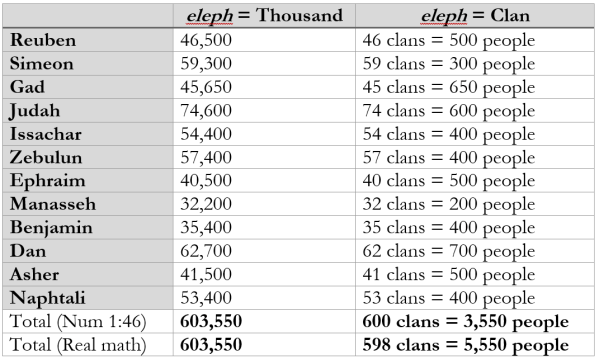
The end result of this approach produces a tiny population for the nation of Israel and also makes Moses incapable of doing basic math. The total number of clans is wrong! If we add the supposed clans together, we get 598 clans, but Moses apparently gets a total of 600. Furthermore, in Exod 38:25 half a shekel was given for each person in the census, which came to 301,775 shekels (half of 603,550). This math does not fit with the eleph = “clan” approach.
Exod 38:25-26 The silver of those of the congregation who were numbered was 100 talents and 1,775 shekels, according to the shekel of the sanctuary; a beka a head (that is, half a shekel according to the shekel of the sanctuary), for each one who passed over to those who were numbered, from twenty years old and upward, for 603,550 men.
Scholars like Petrie and Colin Humphreys who want to ignore these verses in order to promote their proposals are not taking every verse of the Bible seriously; they have to ignore the totals that the authors give for their own calculations! More debunking of the clan approach can be found here.
Exaggerated Numbers

David Pouts proposes that the large numbers can be understood as an exaggeration that is meant to glorify the God of Israel. He bases this claim on what are commonly understood to be exaggerated numbers in military conquest texts across many nations in the Ancient Near East. Consider these texts:
Assyrian Text concerning Arik-den-ilu (14th c. BC)
“He plundered the land of Halahi permanently. He killed 254,000 men; he brought about their defeat. He took captives to Assyria…”
The Assyrian text speaks of a quarter million people being killed in a battle in some distant land, something that no one back in Assyria could verify. Pouts proposes that the text embellishes the numbers in order to make the king look more glorious to his people.
Shalmaneser I’s inscription (13th c. BC)
“I butchered their army, but those 14,000 who remained alive I blinded and carried them away.”
Tukulti-Ninurta I’s inscription (13th c. BC) – the son of Shalmaneser I
“On my year of ascent to the throne, in the first year of reign, I carried away 28,000 Hittite warriors from the other side of the Euphrates.”
Pouts points out that Shalmaneser’s son (Tukulti-Ninurta) claims to have immediately upon taking the throne outperformed his father’s accomplishment by exactly doubling his achievement. He interprets the son as trying to impress his subjects by claiming to have achieved twice what his father could have achieved, despite the fact he most likely did not take away 28,000 Hittite slaves.
The benefit of this approach is that it does not attempt to deny the math like the previous proposal did. Pouts also wisely looks to how people in the days of Moses were writing about army numbers in order to see if those writings would give us insight into writing conventions that were forgotten thousands of years ago. After all, if everyone in the known world was bloating the army numbers so that it was expected by every reader that “300,000” really means something like “30,000”, then it would be reasonable to expect Moses to use the same writing conventions lest his reader should misunderstand. However, deceit and pride are the foundation of such writing conventions, and I severely doubt that God would allow Moses to adopt writing conventions whose very foundation is pride and deception. We’re better off looking for an answer to this problem that doesn’t imply that God needs to be glorified by lies. Also, the idea of exaggerated numbers does not fit with the half-shekel tax of Numbers 38:25-26.
Tens as Nuclear Families
Consider again with me the numbers in the first (Num 1) and second census (Num 26). What do you automatically assume about the fact that none of the tribes ends in anything other than a zero? If you don’t assume that these numbers are exaggerations or mere guesses, you most probably assume that these numbers are rounded.
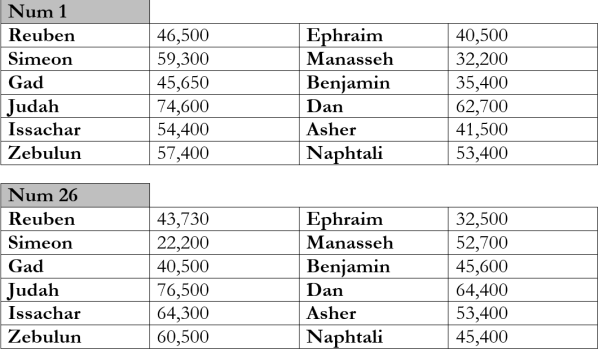
According to our conventions, it is perfectly acceptable to round numbers, and hardly anyone accuses those who round numbers of lying when they do so. Let’s consider what it would mean for another culture in a distant place and time to have their own conventions that everyone understood in that place and time.
Exodus 18:24-26 So Moses listened to the voice of his father-in-law and did all that he had said. And Moses chose excellent men out of all Israel and made them heads over the people, leaders of thousands, of hundreds, of fifties, and of tens. And they judged the people at all times; the difficult matter they would bring to Moses, but every minor matter they themselves would judge.
Let’s consider what Jethro’s advice means for a nation that is composed of tribes, clans, and families. Instead of imagining Moses as completely overthrowing the established societal hierarchy in each tribe, clan, and family, we should imagine him as working within the already established hierarchy of each tribe; unless there was a good reason not to make the head of a clan the judge over that clan, it makes the most sense for Moses to look to clan heads to judge their own clans. So, let’s interpret heads over tens, fifties, hundreds, and thousands within the framework of tribes.
Consider for a moment a family that is like the twelve sons of Jacob. Does it make great sense to split up the family so that ten sons are overseen by Jacob and the two other sons are overseen by someone else? It makes far more sense to label a family as a ‘ten,’ such that Jacob is still the judge over his own family, despite the fact that his family is actually composed of twelve instead of exactly ten. Similarly, a man who only has three sons can also be considered head over a ten. Since he will likely be trying to have more sons (children were the only insurance of care in old age back then), we should think of his family as a ten-in-the-making.
A “ten” is a nuclear family. A head over fifty would be one level above the nuclear family, which is the extended family (uncles and their children). A head over hundreds is likely a clan leader, since he is over many extended families. A head over thousands is probably the tribe leader and he oversees the clan leaders.
So, let’s imagine five brothers who all get married and thus each form their own families. The first brother is newlywed and has no children, so he is a family unit composed of 1 male. The second brother has two sons, so he is a family unit composed of 3 males. The third brother has three sons, so he is a family unit composed of 4 males. The fourth brother has one son, so he is a family unit of 2 males. The fifth brother has six sons, so he is a family unit of 7 males. The father of these brothers is the head over the brothers, and he is the “head over fifty.” So, adding the father of the brothers to the total that each brother represents, we have 18 males that compose the group of “fifty.”

This approach explains why all the census numbers are multiples of ten; each married male represents a unit of ten. In this view, the population could potentially be much smaller in terms of literal numbers. For the sake of creating an example, taking the fifty = 18 people example we just discussed, this would change the population from 603,550 men to 217,278. Now we’re in a range of numbers that makes much more sense; the nation would have been smaller than the combined city states of Canaan and would have struggled to maintain the wilderness and the animals.
We can imagine Moses taking the census by asking the judges over thousands (tribal leaders) to find out from the judges over hundreds (clan leads) to find out how many tens (nuclear families) there are in each tribe. He then took the totals and added them up for the nation. The whole nation would have understood the conventions being used.
The 301,775 shekels given for the sanctuary in Exod 38:25-26 can be understood as being calculated based on each ‘ten.’ Each nuclear family is responsible to give five shekels for the support of the sanctuary (Exod 30:12-16).
Since the firstborn are not tallied in the same way, we get a specific number for them: 22,273 firstborn aged one month and older (Numbers 3:43). Since Levi has 2,200 ‘tens’ (nuclear families that include children one month and older), we subtract 22,000 from 22,273 and have 273 remaining who have no replacement. So, YHWH has those 273 firstborn pay a redemption price so that they can be excluded from serving at the tabernacle.
Unlike the “exaggerated numbers” approach, there is something systematic going on here that would have been understood by everyone in Israel. No one would have looked at the numbers and thought that Moses was exaggerating in some attempt at flattering YHWH by pretending the nation was larger than it really was. Reuben’s 46,500 would have been understood as communicating that there was 4,650 families, each ranging between 1-10 males. The fact that we look at these numbers now and think of them as exaggeration has more to do with us imposing our modern conventions upon the past than it does with us trying to grapple with the conventions that previous generations found helpful.
Final Thoughts
The numbers in the Ancient Near Eastern texts similarly are sometimes counted as we would expect them to be and other times seem to be quite bloated, even in the same document. Rather than accusing everyone in the ancient world of lying at random times, we could understand them as using a valuation system where specific numbers are representative for something like a contingent, a clan, or a family. Thus, those numbers that are not denominators of 10 are literal head counts as we do today, and those that are denominators of ten are representative valuations.
At this time, this representative valuation approach makes the best sense to me and has the benefit of not requiring that we accuse the historians of Ancient Near Eastern civilizations of randomly lying throughout the documents that they wrote.
 VersesVersusVanity
Leave a comment