

In this post:
- Where does the number 2.2 million come from?
- The Encampment is Too Small to Fit 2.2 Million!
- There Would Not Have Been Enough Food!
- The People Would Have Entered Canaan Before They Left Egypt
- It would be impossible for that many people to cross the Red Sea in the short time indicated.
- There Is No Evidence from Egyptian Inscriptions That the Exodus Happened
- The Firstborn Population is Too Small!
- The Least of All the Nations?
- Israel’s Army is Small Elsewhere
Introduction
It is commonly claimed that the number of people reported to have left Israel during the Exodus was unrealistically large. Some prominent arguments are that there would not have been enough food for 2.2 million people prior to the provision of mana, one of the locations that Israel camped in was too small, and other parts of the Bible contradict the large numbers. There are supposedly so many problems that it would be very naïve of you to believe that so many people went on an Exodus out of Egypt! We’re going to explore some of the common arguments against a literal interpretation and see how valid they are.
Where does the number 2.2 million come from?
Since Exodus 12:37 says that 600,000 adult males left Egypt, we can extrapolate some things that are probably true. Each one likely had a wife and a child or two, so 600,000 men + 600,000 women + 1,000,000 children = 2,200,000 people. We’re going to treat the number as 2.2 million for simplicity’s sake, although it may have been a bit more or a bit less.
The Encampment is Too Small to Fit 2.2 Million!
Michael Heiser argues that the space where Israel camped, which is approximately a distance of 7 miles between Beth-jeshimoth as far as Abel-shittim in the plains of Moab (Num 33:49), is far too small to fit a massive population of 2.2 million. The population density of this encampment would be greater than the population of New York City with its high-rise buildings! Because it is far too small, the numbers in the Exodus must be much smaller than 2.2 million. That sounds reasonable, right? The math, however, proves Heiser to be very mistaken.
Refuted: The Camp is Big Enough
If we assume that the camp was 7 miles long and 7 miles wide, according to the square-like camping arrangements of the wilderness wanderings, we have 49 square miles. How much space would each person have if 2.2 million people spread out over 49 square miles?
1 square mile = 5,280 feet x 5,280 feet = 27,878,400 square feet
49 square miles = 49 x 27,878,400 square feet = 1,366,041,600 square feet
Next, we divide the number of square feet by the number of people (2.2 million):
1,366,041,600 square feet ÷ 2,200,000 people = 620.928 square feet
So, each person would have 621 square feet of space to spread his tent, possessions, and animals over. Let’s visualize this. As you can see, 25 feet by 25 feet (625 feet squared) leaves lots of room for an individual Israelite to have a large tent, a carriage, luggage, and a small group of animals to sacrifice.
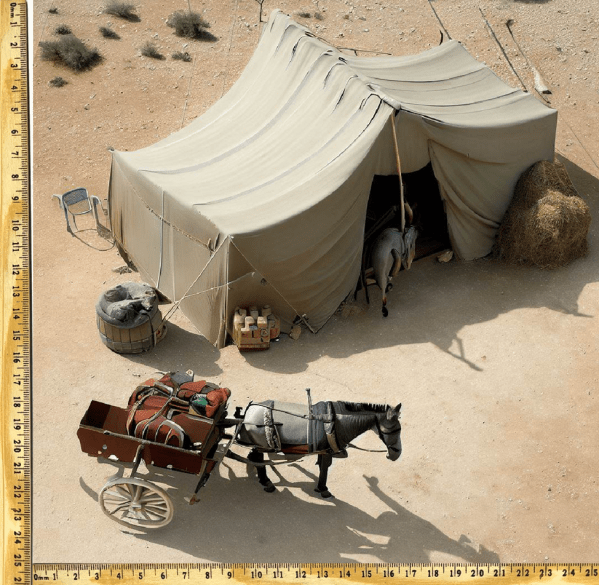
The Israelites were probably not so individualistic that each person had their own tent; it makes good sense for families to share a tent, which then leaves even more room for animals and supplies. There is no reason whatsoever to claim that there was not enough room between Beth-jeshimoth and Abel-shittim for 2.2 million Israelites to encamp. Also, New York City isn’t just a collection of high-rise apartment and condo buildings. There are shopping malls, government buildings, streets, stores, etc. Heiser made the situation sound riduculous when it was never ridiculous.
There Would Not Have Been Enough Food!
Michael Heiser again argues that since the Israelites travelled without any supply of manna for 45 days (Exod 16:1) and Exod 12:39 says that they had not prepared provisions for the journey (they only managed to take a little unleavened bread with them), then they would require a ridiculous amount of food. If a family of five sacrificed one sheep (or some other animal) each day to feed themselves, the Israelites would have had to slaughter 120,000 sheep every day —meaning, the Israelites would have had to leave Egypt with 5.4 million animals. Even if they ate an animal a third of the time, meaning 15 times an animal was sacrificed per 5 people, they still would have had to slaughter 40,000 animals every day and leave Egypt with 1.8 million animals.
Refuted: Sheep Take a Month+ to Eat
The idea that a family of 5 would be eating a whole sheep every 3 days is ridiculous. Let’s once again do some math and see how silly this argument really is.
Weight of the Sheep: A mature sheep can weigh anywhere from 100 to 300 pounds (45 to 136 kilograms), depending on the breed and its health. However, not all of this weight is edible meat. The edible meat yield can be anywhere from 40% to 60% of the live weight. Taking an average weight of 200 pounds and a 50% yield, that’s 100 pounds (45 kilograms) of edible meat.
Daily Meat Consumption: According to dietary guidelines, a typical portion of meat per meal is about 3 to 4 ounces (85 to 113 grams). If each person eats meat three times a day, that’s 9 to 12 ounces per day. For a family of 5, they would consume between 45 to 60 ounces (1,275 to 1,700 grams) per day.
Now, let’s calculate: If the family consumes on the lower end, 45 ounces a day, then 1,600 ounces (100 pounds) of sheep meat ÷ 45 ounces a day gives us 35.5 days. If these people only ate twice a day instead of three times, then they’d have food for 43 days. Even if these people ended up skipping eating every now and then, as people rationing their food would do, a single sheep would be sufficient for the journey. But would the meat last without going bad for that long?
The ancient peoples learned dehydration methods that allowed them to preserve meat for over a month. Removing the fat and salting the meat would prevent the meat from spoiling as it dries out in the sun. Thin slices left to dry in the sun would become like jerky within 1-2 days. Assuming the Israelites had carts, they could have laid the meat out on the cart as it travelled. While some meat became jerky in the sun, other meat would sit in salt and be preserved until it had its time to dry in the sun. Once dried, the meat could last weeks.
So, it seems that 5 people can survive on one sheep for the entire 45-day journey. Is it really so inconceivable that there was one sheep for every 5 people leaving Egypt? After all, Israelites didn’t only make bricks; they also did shepherding work because the Egyptians thought shepherding was disgusting work (Gen 46:34). But weren’t all the sheep killed in the Exodus story? Exodus 9:4 tells us that God specifically spared the livestock of the Israelites; meaning that there should have been more than one sheep per every 5 people.
The Line Would Have Entered Canaan Before They Left Egypt!

Some people point out that if the Israelites walked in 5 columns, the people at the beginning of the column would enter Canaan before the people at the end of the column would exit Egypt. So, it is very silly to suggest that a group this big could have travelled as is described.
Refuted: Unreasonable Column Number
First, it is important to recognize that 2.2 million people can fit in one square mile. In fact, nearly 12 million people can stand shoulder-to-shoulder in one square mile. So, if the Israelites travelled in anything like the shape of a square, they would make a formation that is less than one square mile in size. The distance between Goshen (Egypt) and Beersheba is about 220 miles, so we have no problem here unless we propose that everyone lined up in 5 columns (which is an unlikely thing for 2.2 million people to do).
It would be impossible for that many people to cross the Red Sea in the short time indicated!
Some scholars claim that it would not have been possible for 2.2 million people to cross the Red Sea in the time span indicated in Exodus 14:21-24.
Refuted: More than enough time
Let’s do the math and see how this claim stands up. We’ll be generous and assume that the Israelites only had 3 hours to cross the water (they actually had the entire night), and let’s assume that they crossed one of the broader portions of the Red Sea (6 KM) instead of one of the narrower (1.5 KM).
If we assume that each person needs 0.36 m2 cm space around him to move comfortably, then 2.2 million people would need 792,000 m2 of space. If we assume that the pathway that God created for the Israelites is 500 meters wide and 6000 meters long, there would be 3,000,000 m2 distance for this group to cover. If they travel at a slow walking pace of 2 km per hour (normal walking pace is 5.5 km per hour), then they could cross the distance within 3 hours. Even assuming a leisurely stroll across one of the wider parts of the Red Sea and a reduced amount of time, there is no problem with 2.2 million people crossing the Red Sea during the night. Ultimately, this claim is easily debunked.
There Is No Evidence from Egyptian Inscriptions That the Exodus Happened!
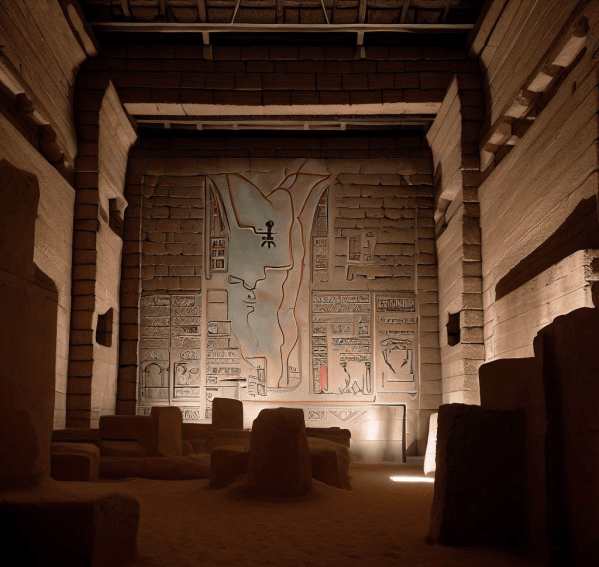
One common claim is that there is no proof in Egyptian writings that anything like an Exodus ever took place—there is no evidence that a huge group of slaves left.
Refuted: Evidence exists
Assuming the conservative view of the Exodus in 1440 BC (which means that the Israelites were wandering in the desert from 1440 BC – 1400 BC), we do see evidence in Egyptian writings that there was a sudden need for a replacement of a massive amount of slaves. Pharaoh Amenhotep who reigned from 1427 BC – 1400 BC went on a campaign into Canaan during some point of his reign in order to bring back slaves. In the Memphis and Karnak Stelae of Amenhotep II, he claims to have brought home 89,600 slaves. So, soon after the Israelites left Egypt and were wandering around the desert, the Egyptians went and brought home the largest haul of slaves ever recorded. It seems like they needed to fill a large gap in the slave population, which fits perfectly with the Exodus story.
More evidence comes from an Egyptian temple wall map (14th c. BC) that lists the enemies of Egypt by the name of their gods. On this map is a people group whose god is YHW, which is understood by scholars to represent YHWH (Yahweh – Jehovah), the name of Israel’s God. See this book for more information.
Additionally, the Merneptah stele (1205 BC) mentions a group of people in the land of Canaan who are called Israel.
So, the Egyptian evidence shows that Egypt needed a huge supply of slaves between 1427-1400 BC and that after 1400 BC that there was a group of people living in Canaan named Israel whose deity was Yahweh.
Number of Firstborn is Too Small

A more significant argument comes from TheTorah.com. The book of Numbers twice states that there were about 20,000 firstborn males over one month of age (22,273, to be exact [Num. 3:39 and 3:46]). Since the total population of adult males over age 20 is a little more than 600,000, there were at least 580,000 non-firstborn males over the age of 20. Since each family could have only one firstborn—and only half of these would be male—this implies families of at least 29 non-firstborn males to firstborn males (580,000 / 20,000), i.e., families of at least 30 males apiece. Including females would roughly double these numbers so that each firstborn male has on average 60 siblings.
Let’s assume that the population was indeed growing at a rate of 29 male siblings for every firstborn male. For there to be 600,000 men over the age of 30, what must the population distribution be? The chart below shows this distribution.
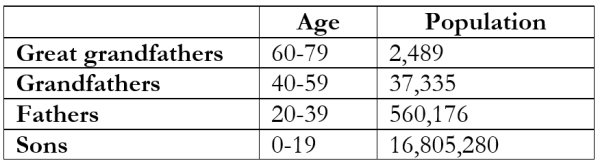
The population of Israel, if it grows at a rate of 29 male siblings for every firstborn male, results in 2,500 people becoming 600,000 in merely two generations. As for the number of children the Israelites would have had if they continued to grow at this rate, it would have been 16.8 million males (33.6 million including females—the largest population in the world at the time). These numbers are beyond what is even slightly possible. The following census at the end of Numbers results in there still being only 601,730 males (Num 26:51). So, we have a real conundrum here if the ratio of firstborn to male siblings were to have consistently been 1:29 across multiple generations.
Resolved
When we look to the narrative in Exodus to explain what is going on. First, we see that God blessed the Israelites to multiply at an extraordinary rate; the more they were persecuted the greater rate at which they multiplied (Ex 1:11-12). Their population rate is claimed to have massively picked up during the end of their sojourn, so perhaps we’re looking at a 1:10 firstborn to siblings ratio for one generation, then the next generation is even higher.
Exod 1:11-12 So they appointed taskmasters over them to afflict them with hard labors. And they built for Pharaoh storage cities, Pithom and Raamses. But the more they afflicted them, the more they multiplied and the more they spread out, so that they were in dread of the sons of Israel.
Upon seeing this explosion, the Egyptians cracked down on the situation to stop the explosion by enforcing slave labor. Unlike the previous labor, the slave labor may have prevented the men from being home to even give opportunity for there to be reproduction. This may have resulted in a decrease in population growth.
Exod 1:13-14 So the Egyptians brutally compelled the sons of Israel to slave labor; and they made their lives bitter with hard slave labor in mortar and bricks and in all kinds of slave labor in the field, all their slave labor which they brutally compelled them to do.
Finally, Pharaoh ordered the midwives to kill the males. The midwives did not obey, so Pharaoh commanded all of his people to ensure that this was taking place and succeeded the second time around (Acts 7:19). This act likely resulted in a decrease in population growth and may have significantly impacted the number of firstborns. After having one’s firstborn murdered, parents likely began ensuring that this didn’t happen to the rest of their children as they began to find creative ways to protect the rest of their children from similarly dying.
Exod 1:15-22 Then the king of Egypt spoke to the Hebrew midwives, one of whom was named Shiphrah and the other was named Puah; and he said, “When you are helping the Hebrew women to give birth and see them upon the birthstool, if it is a son, then you shall put him to death; but if it is a daughter, then she shall live.” But the midwives feared God and did not do as the king of Egypt had spoken to them, but let the boys live. So the king of Egypt called for the midwives and said to them, “Why have you done this thing, and let the boys live?” Then the midwives said to Pharaoh, “Because the Hebrew women are not as the Egyptian women; for they are vigorous and give birth before the midwife can come to them.” So God was good to the midwives, and the people multiplied and became very mighty. Now it happened that because the midwives feared God, He made households for them. And Pharaoh commanded all his people, saying, “Every son who is born you are to cast into the Nile, and every daughter you are to keep alive.”
So, we have a situation that would have both reduced the population growth and caused the number of firstborn to be reduced, such that many of the firstborn had died during the persecution in Egypt. So, when we’re looking at a ratio of 22,000 firstborn to 600,000 men, we’re looking at figures that have been warped through murder. If we assume that the Egyptians had been successful in killing most of the firstborn, such that only ¼ survived, then the real ratio would have been something like six male siblings for every one firstborn.
The Least of All the Nations?
God tells Moses that Israel that the reason for God’s affection has nothing to do with how great the nation of Israel is, since the nation is the least of the peoples. If they were the smallest of the nations, then each Canaanite nation must have been over 2 million strong. The archaeological evidence for the cities in Canaan does not support anything near that amount of people!
Deut 7:7 Yahweh did not set His affection on you nor choose you because you were greater than any of the peoples, for you were the least of all peoples,
Refuted
The Hebrew wording here is as ambiguous as the English. The greatness of the nation could have to do with its size or it could have to do with its significance or majesty. Similarly, the smallness of the nation could have to do with its population number or it could have to do with its insignificance or lowliness. Both options are possible, as is evident from the following verses:
Num 26:54 To the greater (rabab) group you shall increase their inheritance, and to the smaller (maat) group you shall diminish their inheritance; each shall be given their inheritance according to those who were numbered of them.
Gen 18:20 So Yahweh said, “The outcry of Sodom and Gomorrah is indeed great (rabab), and their sin is exceedingly grave.
Isa 7:13 Then he said, “Listen now, O house of David! Is it too insignificant (maat) a thing for you to try the patience of men, that you will try the patience of my God as well?
But if they weren’t smaller than the other nations, then why would they be afraid to fight them? The reason given was the monstrous height of those whom they saw in the land, not the number of people in their army. Also, the Israelites were abused slaves who were freed through terrifying miracles, not brave warriors who won their freedom. So, cowardly behavior from former abused slaves is not exactly surprising.
Israel’s Army is Small Elsewhere
The army mentioned in the days of Deborah was only 40,000 strong (Judges 5:8). If the army was only 40,00 in the days of Deborah, why would we believe it had been 600,000 during the Exodus?
Judges 5:8 God chose new leaders; Then war was in the gates. Not a shield or a spear was seen among forty thousand in Israel.
Deborah’s statement is quite vague. She’s not referring to the people in the battle earlier, since that was only a group of 10,000 (Judges 4:6, 10). So, does she think the entire army of Israel amounts to 40,000? Or was there 40,000 out of the entire potential fighting force who were commonly set aside to deal with troubles? It is best not to use vague poetic texts to draw conclusions.
Up Next
We’ve seen that many of the arguments against a literal interpretation of Israel’s population recorded in the book of Numbers are easily disproven. However, not every argument against a literal interpretation is so easily debunked. In our next post, we will look at the arguments that challenge a literal interpretation and we will see how we can understand the huge numbers.
 VersesVersusVanity
Leave a comment