
Discussed in this post:
There are three stages in history that change the conditions of the afterlife; all three are visualized here.
What are the three Heavens?
Does the Old Testament think of the sky as a solid object?
Before Christ’s Resurrection (Old Testament)
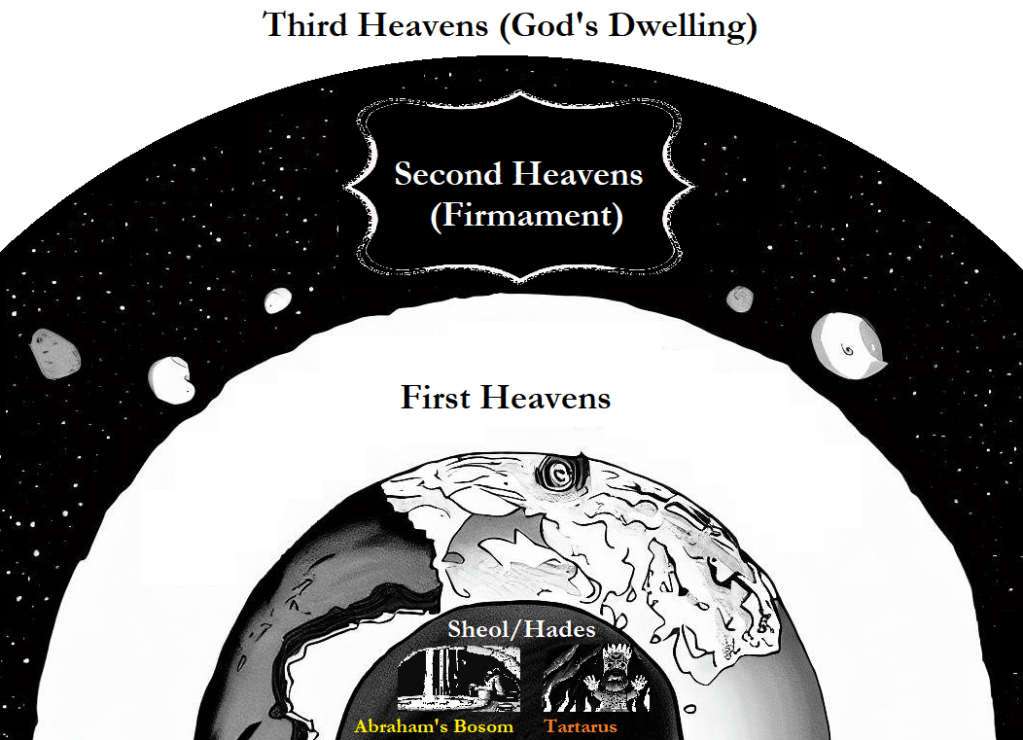
Sheol / Hades
Prior to the resurrection of Jesus, both the righteous and the wicked went to Sheol (also called Hades in the New Testament and in the LXX). Hades was separated between a place for the righteous, which Jesus called “Abraham’s bosom” (Luke 16:22), and Tartarus, where the wicked fallen angels of Genesis 6 and wicked people were punished (2 Peter 2:4).
Although Sheol/Hades is being represented as being in core of the earth in the above illustration, we should probably interpret this metaphorically instead of literally.
See the arguments for this understanding in parts one, two, three, and four of our series on Hell for the scriptural evidence.
First Heaven
The first heaven consists of the atmosphere where birds fly and clouds are located. Birds are commonly called the עוף השׁמים (“birds of heaven”) because they fly through the first heaven. When God separated the waters through the creation of the ‘firmament’ in Genesis 1:6-7, the result was that a space for air and clouds was also created under the ‘firmament.’ This space that was created by consequence of the creation of the ‘firmament’ is the first heaven, and today we call that what we call earth’s atmosphere.
It is the first heaven, the space where humans walk and birds fly, that Satan currently rules over. That is why he is called the prince of the power of the air (Eph 2:2)–he is not the prince of the heaven where the sun, moon, and stars are. The heavenly powers that Christians struggle with are not the sun, moon, and stars, but the hostile spiritual forces who exist in the first heaven (Eph 6:12).
Second Heaven
The second heaven is where God placed the sun, moon, and stars (Gen 1:14) and the birds fly undernearth it (Gen 1:20). Literally, the birds fly “across the front/face of heaven,” which is a reference to how we see birds flying in front of where the sun, moon, and stars are located.
Many mistaken interpreters have claimed that the Israelites believed that the sky was a solid dome based on a verse in Job:
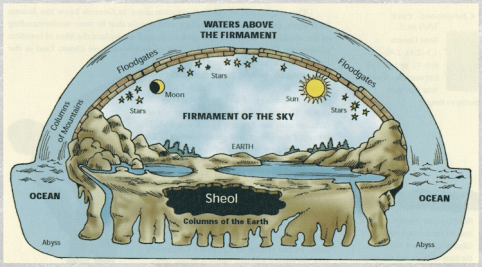
Job 37:18 Can you, with Him, spread out the skies, Strong as a molten mirror?
This misunderstanding comes from a failure to recognize that descriptions like this are poetic ways of saying that God will cause a drought:
Deut 28:22–24 Yahweh will strike you with consumption and with fever and with inflammation and with fiery heat and with the sword and with scorching wind and with mildew, and they will pursue you until you perish. And the heaven which is over your head shall be bronze, and the earth which is under you, iron. Yahweh will make the rain of your land powder and dust; from heaven it shall come down on you until you are destroyed.
In Deut 28:22-24, the sky is made to be like metal as a special curse from God, which is a way of saying that God will not allow it to rain. Lack of rain will make the earth very dry. Nobody is silly enough to claim based on the language in this verse that the Israelite farmers thought the dirt was made of iron, so nobody should be silly enough to try to make this verse say that the Israelites thought the sky was hard like metal. And since heaven poetically becomes like metal when God is cursing Israel, that means that it is not normally like metal. So, would the Israelites normally describe the sky as being hard like metal? No, they wouldn’t.
Some scholars like Ben Stanhope argue based on metaphorical texts from the ancient world that the mountains were viewed as holding up the sky. Although people climbed such mountains and clearly saw that they were not holding up the sky, Ben implies that they were still so dense that they did not believe their own eyes and concluded that the sky was held up by mountains.
He also forgets that the names of items that were known for having specific colors were used for those colors, so a blue brick is a lapis lazuli (a blue stone) brick, and a lapis lazuli sky is a blue sky, not a sky made of lapis lazuli. Through combining many such mistakes and silly proposals, he cobbles together an argument that the Israelites believed in a solid sky.
What Ben thinks is his strongest argument is that the rabbis (the descendants of the Pharisees who failed to understand the Old Testament and crucified their own messiah), hundreds of years after Jesus, wrote about the sky being a solid object. First, this group is famous for being terrible at understanding the Old Testament, so we are not surprised when they misunderstand passages about heaven. Second, the very clear way that the rabbis talk about the sky being solid contrasts with the way the Old Testament never makes any similarly clear statements. Those who think the sky is solid are clear about it and those who do not think it is solid avoid ever making any statements about it being solid. The rabbinic writings demonstrate what we would expect to find in the Old Testament if the Old Testament authors thought the sky was solid, and we find no such evidence in the Old Testament, which shows that the Old Testament authors did not share their opinion.
Firmament
In Genesis 1:6, God creates something called a רקיע (lit. raqia) into which he puts the sun, moon, and stars and renames it as “Heaven.” Some scholars argue that since the word raqia comes from the verb רקע (raqa “to stomp, hit”) and is sometimes used to describe metalworkers who pound metal with hammers (Exod 39:3), then heaven must be hard like metal.
However, this verb isn’t specifically about hammering metal. It’s also used for stamping on human beings (2 Sam 22:42) and dirt (Isa 44:24; Ezek 25:6; Ps 136:6). While metal is hard, dirt is softer, and humans are very soft by contrast. So, this verb is just about shaping and fashioning something through use of force, regardless of how hard or soft it is. The noun רקיע (lit. raqia) that comes from this verb just refers to something that God shaped and formed through his power without communicating how hard or how soft it is. It is a vague term for a location where the sun, moon, and stars are located; the Bible nowhere mentions a material that the second heaven is composed of.
Third Heaven
When Paul was taken up to where God dwells, he said that he was taken to the third heaven (2 Cor 12:2-4). Solomon says that neither the first heaven nor the second heaven can contain God:
1 Kings 8:27 But will God truly dwell on the earth? Behold, heaven and the heaven of the heaven cannot contain You; how much less this house which I have built!
The third heaven is where God dwells and in the Old Testament, saints were not said to dwell there. Though there may have been an exception for Enoch and Elijah (Gen 5:24; 2 Kings 2:10).
After Christ’s Resurrection (Presently)
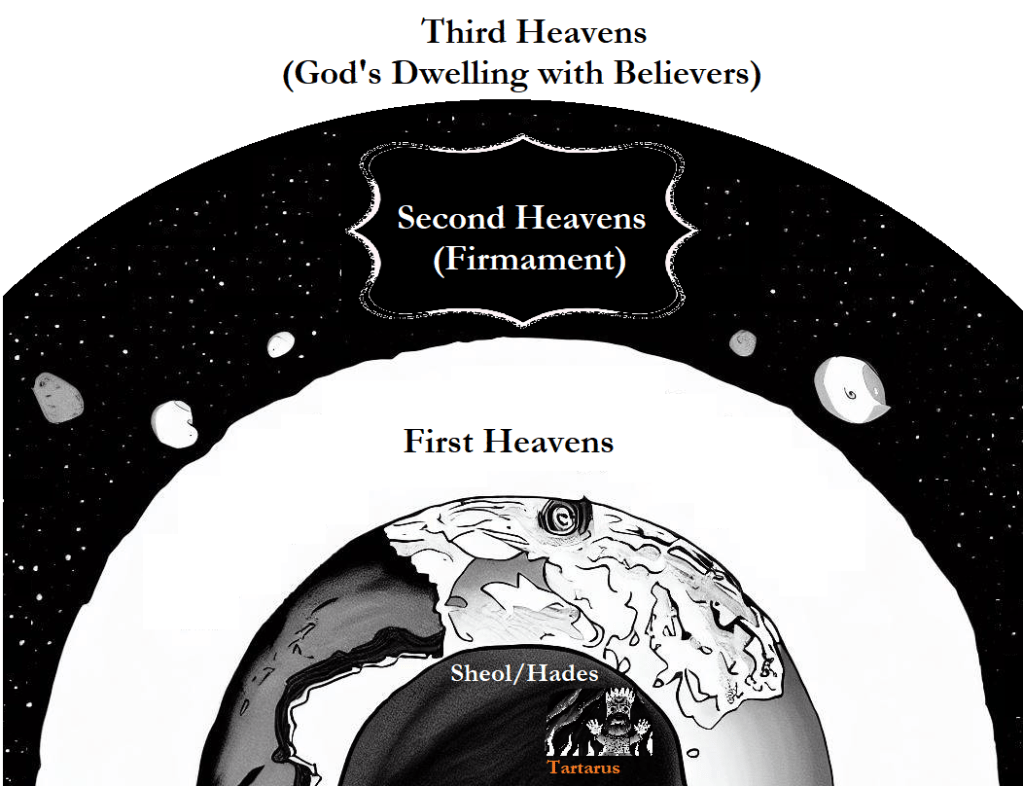
After Jesus gave up his spirit on the cross, he descended into Sheol/Hades and proclaimed his accomplishment of salvation to the fallen angels who had sought to ensure the damnation of humanity back in Genesis 6. He then brought up those who were in the good part of Sheol/Hades (Abraham’s bosom) into heaven. Now believers go straight to heaven when they die and the good part of Sheol/Hades is empty.
See the arguments for this understanding in parts three and four of our series on Hell.
Future (New Earth and the Lake of Fire)
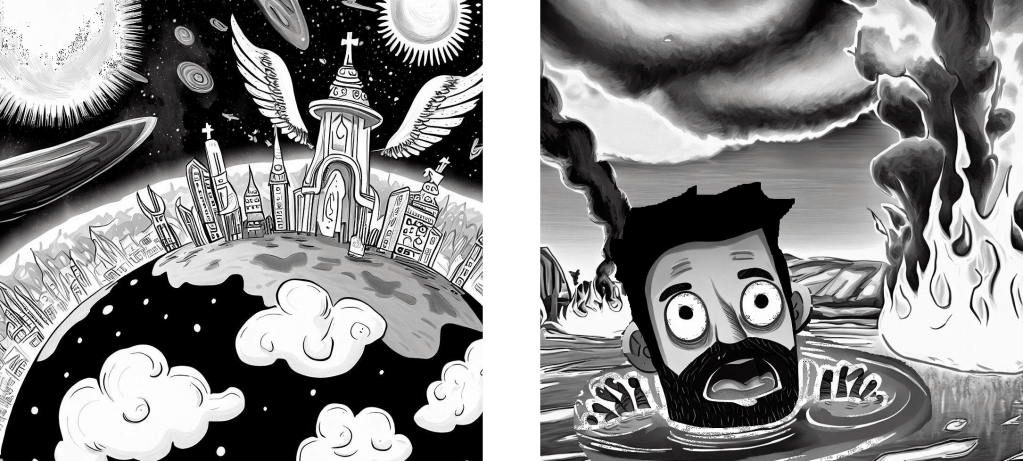
By the time God creates the New Heaven and New Earth at some point in the future, Sheol/Hades will cease to exist (Rev 20:14), and the wicked will be in the lake of fire in their resurrection bodies (Rev 20:15). Believers, on the other hand, will dwell on the New Earth where Jesus will be present (Rev 20; 21:3).
See the arguments for this understanding in parts three and four of our series on Hell.
Up Next
Does punishment for those who are resurrected for the lake of fire result in eternal conscious torment or eventual annihilation? We will consider the main texts in support of both positions beginning with the next post.
 VersesVersusVanity
Leave a comment