

In our third part of our series, we will look at how the concept of the underworld is used in New Testament.
Hades in Later Greek Literature
The term that the King James most often translated as Hell in the New Testament is the Greek term ᾅδης (“Hades”). Although Hades was once just the name of the Greek deity over the realm of the dead, it came to be associated with the realm of the dead itself in later literature.
A couple hundred years before the Jesus was born, the Greek concept of Hades had been fully developed. When people died, their spirits went to the realm of Hades to be judged. The more righteous a person was during life, the better the afterlife he experienced. The more wicked a person was during life, the worse the afterlife. Both the punishment and the reward areas were all in the underworld, divided from each other by some impenetrable unspecified means.
When righteous people went to Hades, it was assumed that they were going to be rewarded in the good part of Hades. When wicked people went to Hades, it was assumed that they would be punished in the bad part of Hades.
New Testament Evidence
The term Hades only appears ten times in the New Testament. Four times it is used in parallel with Death, making the two seem synonymous (Rev 1:18; 6:8; 20:13-14). Twice Jesus uses the language of Isaiah 14:12-15 that shows that he understands the Old Testament spiritual realm of שְׁאוֹל (“sheol”) to be the same thing as Hades (Matt 11:23; Luke 10:15). Peter uses Hades twice in a way that could either refer to the literal grave or to the spiritual realm of the dead (Acts 2:27, 31). Jesus uses the term one time in a way that seems like it could refer to either the whole realm of the dead or to just the part where the rich man is in torment (Luke 16:23). And Jesus also uses the term in a way that could make good sense if it were about the grave and death (death cannot defeat the kingdom of God), the general realm of the dead (spirits currently residing in the good part of Hades will be resurrected), the bad part of Hades (those who would have been damned to the bad part of Hades are saved from the punishment they deserve), or the bad part of Hades as a representation of the forces of evil in the world (since Satan wants people to go to Hell, Hell is closely associated with Satan) (Matt 16:18).
- Matthew 11:23 And you, Capernaum, will not be exalted to heaven, will you? You will be brought down to Hades! For if the miracles that occurred in you had occurred in Sodom, it would have remained to this day.
- Matthew 16:18 And I also say to you that you are Peter, and upon this rock I will build My church; and the gates of Hades will not overpower it.
- Luke 10:15 And you, Capernaum, will not be exalted to heaven, will you? You will be brought down to Hades!
- Luke 16:23 And in Hades he raised his eyes, being in torment, and saw Abraham far away and Lazarus in his arms.
- Acts 2:27 for you will not abandon my soul to Hades, nor will you allow your holy one to undergo decay.
- Acts 2:31 he looked ahead and spoke of the resurrection of the Christ, that He was neither abandoned to Hades, nor did His flesh suffer decay.
- Revelation 1:18 and the living One; and I was dead, and behold, I am alive forevermore, and I have the keys of death and of Hades.
- Revelation 6:8 I looked, and behold, an ashen horse; and the one who sat on it had the name Death, and Hades was following with him. Authority was given to them over a fourth of the earth, to kill with sword, and famine, and plague, and by the wild animals of the earth.
- Revelation 20:13 And the sea gave up the dead who were in it, and Death and Hades gave up the dead who were in them; and they were judged, each one of them according to their deeds.
- Revelation 20:14 Then Death and Hades were thrown into the lake of fire. This is the second death, the lake of fire.
Parable of the Rich Man and Lazarus (Luke 16:23)

The mention of Hades in Jesus’ parable of the rich man and Lazarus is best understood as referring to the whole location. Abraham and Lazarus are on the good side of Hades and the rich man is suffering on the bad side of Hades. The fact that Jesus can so casually refer to Hades like this without giving more explanation shows that he expects everyone to fully understand what he is talking about. Everyone knew about Hades and how rewards and punishments worked.
1 Enoch

As further evidence that everyone understood this, check out the following quote from the Book of the Watchers from 1 Enoch. This book dates back to around 250-200 BC, if not earlier. Notice how both the divisions of Hades and the idea that the underworld is located in the west are mentioned? Do you also notice how there is water in the place of the righteous people, just like Abraham and Lazarus had water where they were?
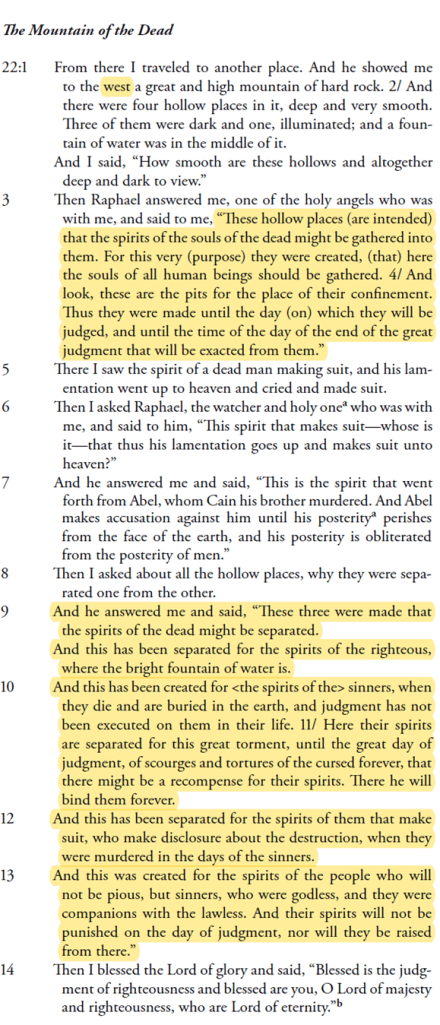
As you can see, the Jews of Jesus’ day generally held to the same understanding of Hades as the Greeks did, which they had borrowed from the Canaanites long ago. Each society had their own nuances on the idea of the underworld, but there was a lot of general overlap.
You can find a free translation of the book of Enoch here. But the one I prefer is the more recent translation found here.
Hell and Hades
The concept of Hell as it is commonly thought of today as a spiritual realm where people are punished only relates to the bad part of Hades. The reason that the most recent modern translations like the NASB 2020 and the Legacy Standard Bible do not translate Hades as Hell is that it is misleading. Hades contains a place like Hell, but Hades is not Hell.
Do Believers go to Hades or to Heaven?

If believers were going to the good part of Hades even in the days when Jesus walked the earth, then does that mean that believers still go to Hades today? No, it does not! Jesus’ work of salvation on the cross changed where believers go when they die. Consider this verse:
2 Corinthians 5:6–9 Therefore, being always of good courage, and knowing that while we are at home in the body we are absent from the Lord— for we walk by faith, not by sight— we are of good courage and prefer rather to be absent from the body and to be at home with the Lord. Therefore we also have as our ambition, whether at home or absent, to be pleasing to Him.
God is consistently said to be in Heaven, which is in contrast to the underworld (Sheol/Hades) that is below Heaven. For Paul to speak of being in the Lord’s presence, he has to have Heaven in mind and not just the good part of Sheol. Also, Paul mentions that it is his ambition to please God even when he is absent from the body, which means that he will be conscious and active while in God’s presence in Heaven.
So, what happened? How is it that now believers go to Heaven instead of the good part of Hades? Unfortunately for us, the New Testament authors never address this issue directly. We can look at the at what is said and infer what is probably true. But no matter how reasonable we find our inferred explanation to be, we must not make disagreements over this unclear issue into a reason for division between believers. What follows is my best attempt at answering this question in a way that is most consistent with what is stated in scripture.
Between the Cross & The Resurrection, Jesus Brought Believers Out of Hades

1 Peter 3:18–22 For Christ also suffered for sins once for all, the righteous for the unrighteous, so that He might bring you to God, having been put to death in the flesh, but made alive in the spirit; in which also He went and made proclamation to the spirits now in prison, who once were disobedient, when the patience of God kept waiting in the days of Noah, during the construction of the ark, in which a few, that is, eight persons, were brought safely through the water. Corresponding to that, baptism now saves you—not the removal of dirt from the flesh, but an appeal of a good conscience to God—through the resurrection of Jesus Christ, who is at the right hand of God, having gone into heaven, after angels and authorities and powers had been subjected to Him.
I understand Jesus being “made alive in the spirit” as being a reference to him not being confined to the realm of the dead, but being able to go about freely as he chooses in his spiritual state prior to his resurrection. It is in this state that he goes to Hades and proclaims his victory over the spirits in prison—the sons of God from Genesis 6. Although they did succeed in getting God to flood the world in judgment, killing most of mankind, Jesus nonetheless accomplished salvation for man.
This proclamation of victory is then followed by Jesus leading those who were held in the good part of Hades up into heaven. Paul speaks of Jesus descending into the underworld (Eph 4:9) and leading captives up into Heaven (Eph 4:10). In a sense, when Jesus led those captives of Hades into Heaven, he also led everyone who would have gone to the good part of Hades into Heaven as well, since their destiny after death is to go straight to Heaven. Of those who had their destiny changed from descending to Hades into ascending to Heaven, he gave some of them to the church as apostles, prophets, evangelists, pastors, and teachers (Eph 4:11-12).
If I have mistakenly inferred the wrong connections between these passages, then the New Testament is simply silent on the subject of how the destiny of believers changed from the good part of Hades to Heaven. Ultimately, what truly matters is the fact that we are granted the privilege of dwelling in God’s presence because of Jesus’ salvific work on our behalf.
Is Hell ever mentioned in the New Testament?
We’ve seen that the word Hades involves a place like Hell, so the New Testament definitely assumes that a place like Hell exists. But does the New Testament ever specifically mention Hell? We’ll look at verses that appear to talk specifically about Hell in our next part of this series.
 VersesVersusVanity
Leave a comment