
Why care about Historical and Cultural Contexts?
Why should we care about the historical and cultural contexts that the Old Testament was written during? When we write books, e-mails, or even text messages, we assume that the people we are talking to do not need us to explain everything to them. Imagine if you had to explain what a car was every time you wanted to talk about your car! The reason we don’t have to explain such things to the people we communicate with is that we all share many common experiences and facts about the world that we can safely assume are known by those we have conversations with.
The Israelites also took lots of things for granted and didn’t feel like they needed to always explain the meaning of every word and concept that they used. So, when we’re reading literature that was written to the ancient Israelites, it is important for us to know what sorts of things they’d be taking for granted. Since God is a good communicator, he knew what things the Israelites took for granted and didn’t see a need to explain the things that no one needed an explanation for at the time. When we read the Old Testament now, we have many questions that the original readers didn’t have, so we have to do extra work to make up for our lack of knowledge.
That’s why it is so helpful to read literature from around the same locations where the Israelites lived. We also want to make sure we read not only literature that was written during the same time as when the Israelites lived, but we also want to read the literature that was written before Israel left Egypt because classics have a way of influencing culture for a very long time.
So, on our topic of Hell, we want to see what the world around Israel believed. If most people believed in an afterlife where some people suffered and others didn’t suffer, then there would be no need for the Bible to explain that concept. What we’d expect to see is references to this afterlife that don’t try to explain that afterlife. And it is exactly those sorts of references that we find.
Summary Chart
Below is a chart that I created based on my own research and the discussions on afterlife beliefs in Egypt and Mesopotamia in a very recent academic book: Ancient Roots of Creation and Afterlife Beliefs. For the Greek literature, I relied mostly upon The Routledge Handbook of Greek Mythology.
Afterlife Beliefs in Ancient Near Eastern Cultures

Mesopotamia
Abraham’s homeland of Mesopotamia had a view of the afterlife that was entirely based upon the grave’s connection to the underworld, at least as far as the few texts that discuss the subject are concerned. In the Sumerian story Gilgamesh, Enkidu and The Nether World (2000-1750 BC, at the latest). Gilgamesh asks Enkidu a series of questions concerning what Enkidu saw in the underworld after Enkidu returns from sojourning there:
“Did you see him who had one son?”
“I saw him.”
“How does he fare?”
“He weeps bitterly at the wooden peg which was driven into his wall.”
“Did you see him who had two sons?”
“I saw him.”
“How does he fare?”
“He sits on a couple of bricks, eating bread.”
“Did you see him who had three sons?”
“I saw him.”
“How does he fare?”
“He drinks water from a saddle waterskin.”
“Did you see him who had four sons?”
“I saw him.”
“How does he fare?”
“His heart rejoices like a man who has four asses to yoke.”
“Did you see him who had five sons?”
“I saw him.”
“How does he fare?”
“Like a good scribe he is indefatigable, he enters the palace easily.”
“Did you see him who had six sons?”
“I saw him.”
“How does he fare?”
“He is a cheerful as a ploughman.”
“Did you see him who had seven sons?”
“I saw him.”
“How does he fare?”
“As a companion of the gods, he sits on a throne and listens to judgments.”
“Did you see the spirit of him who has no funerary offerings?”
“I saw him.”
“How does he fare?” “He eats the scraps and the crumbs tossed out in the street.”
As can be seen from the above text, the more children a man has, the more blessed he is to become in the afterlife (probably because more children mean more offerings at the grave). The texts give no indication that there was a separation between the wicked and the righteous, although this might be simply because the texts that discussed this idea were lost thousands of years ago. It is also possible that wicked people had few offerings given to them and righteous people had more offerings given to them because they were well-liked, but there is nothing stated about this. Even if we think speculations like this are reasonable, it is best not to impose beliefs upon the Mesopotamians and then count those imposed beliefs as evidence. So, we’ll say that they believed in an afterlife, but that righteousness and wickedness had no part in determining what that afterlife was like.
Egypt

Egyptian afterlife beliefs were not entirely consistent. In some beliefs, the wicked were devoured by spirits in the afterlife. In others, the wicked were cast into a realm of chaos while naked and blind. It’s difficult to tell which belief was the most popular one, but the end result is negative for wicked people in the afterlife. Meanwhile, righteous people always get a positive eternity and dwell with divine beings. Anubis would judge a person’s soul; the more weighed down with guilt, the more likely that soul would be sent for punishment.
The afterlife happened in a spiritual realm below the earth that had some sort of connection to the physical grave where a person was buried, which allowed the family members to give help to the deceased individual by doing rituals at the grave.
In short, the Israelites that Moses wrote the book of Genesis to were well aware of the idea of an afterlife that is based on how one lived during one’s life. They understood that the afterlife was horrible for wicked people and wonderful for righteous people, and they did not believe that the afterlife for righteous people was in heaven.
Canaan
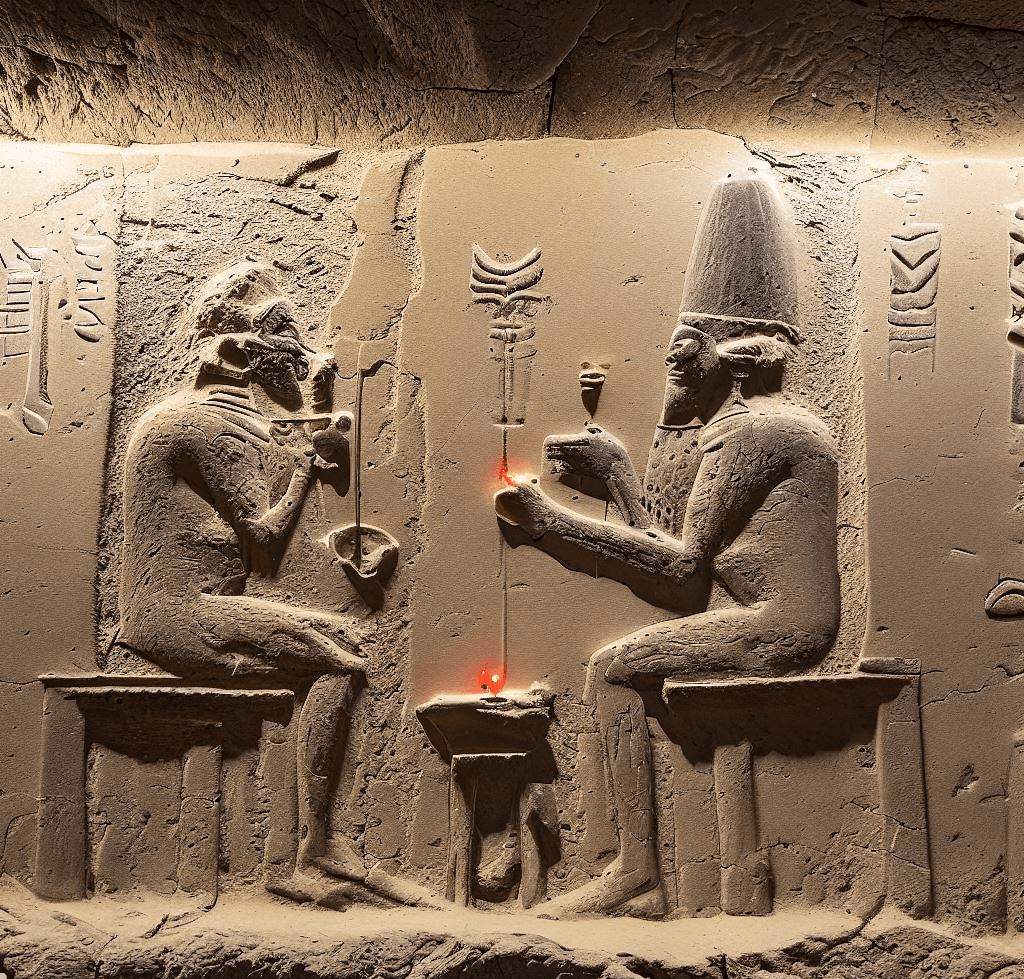
The texts from the land of Canaan are similar to the Mesopotamian texts in
the sense that they do not give us many of the details that we would hope to
find. We do see that those who died went to the underworld, where they remained
in a conscious state and could interact with other dead spirits. We also see
that kings wished for their descendants to pray for them to be permitted to
dine with the gods, like the god Hadad.
King Panammu wrote: “Whoever of my sons grasps the scepter and sits
upon my seat as king over Yaudi and confirms his rulership and sacrifices to
Hadad and mentions the name of Panammu, saying: “May the soul of Panammu eat
with Haded, and may the soul of Panammu drink with Hadad!”
So, it appears that some could dine with the divine while others did not get the privilege. Whether there was any relationship to righteousness or wickedness during one’s life is unknown. Again, this does not mean that they did not have such a belief. When we have so few texts on the subject on the afterlife, we can’t use the absence of evidence to prove that the Canaanites did not hold such a belief. Neither can we use that silence to say that they did hold such a belief. Instead, we need to look for more information. So, we turn to the Greeks.
Greeks

Although the Greeks are far removed from Israel, they tended to borrow mythology, names, and concepts from the Canaanites. For example, the name Adonis (the Greek hero) derives from the Semitic word Adonai (“lord”). The stories of Zeus appear to be modified stories of the deity El seen in the Canaanite literature. Scholars of Greek and Ugaritic literature consider Homer to have borrowed from the plots of Canaanite texts and utilized the kingship model of the Semites. Homer also appears to have borrowed a Semitic view of the afterlife, where everyone goes to an underworld and continues on in some spiritual sense. Excavations have shown that the Greeks had a fortress near Ugarit in Canaan and that people of Phoenician origins were dwelling among the Greeks in Rhodes. So, we have good reason to suspect that the Greek view of the afterlife reflects the Canaanite view of the afterlife that the Canaanite texts sadly do not give us many details about.
According to Homer (8th c. BC), some good characters like Menelaus go to Elysium, which is a location of bliss and happiness. Meanwhile, according to Hesiod (7th c. BC), especially wicked people go to Tartarus, which is a location of punishment for wicked people. Although, the few bits of information we get do not specify that everyone goes to either Elysium or Tartarus, it is possible that the view held by the ancient Greeks was one where some people went to the Elysian Fields, others went to Tartarus, and the majority were all together in some other part of the underworld in a dreary and joyless condition. However, this would appear to fit well with the idea that people of excellent quality get rewarded while everyone else gets differing levels of eternal punishment, whether severe (torment in Tartarus) or light (joyless and dreary existence in the general underworld).
The earliest mentions of both the underworld and Elysium place both of them far west of Greece. It isn’t entirely clear why both would be far west of Greece. Perhaps the Greeks saw the sun set in the west and assumed that an entrance to the underworld must exist in the west. Although the underworld is underground and Elysium is on an island, their mutual location in some mythical western location connects them in ways that the early authors do not explain. Later authors (5th c. BC) make clear that Elysium is part of the underworld.
Although we can’t be entirely sure whether the Greeks modified the concepts and myths that they copied, it is likely that the depictions of the underworld in the earliest Greek literature do reflect what the Canaanites believed about the afterlife.
Conclusion
When Moses wrote his books for the Israelites, he wrote in a context where everyone believed in an afterlife in the underworld. Some cultures, like the Egyptians and the Greeks, give us clear evidence that they believed in rewards and punishments in the afterlife. The Canaanites were not as clear, although there are hints in their texts. Also, the relationship between Canaanite literature and Greek literature implies that the Canaanites probably had a very similar view of the afterlife to that of the Greeks.
So, Moses had no reason to explain that there was an afterlife that had rewards and punishments based on how a person lived, since he was writing to a nation that had spent over 400 years in Egypt (Egypt being a place with a robust conception of judgment and afterlife in the underworld).
When people say that Hell doesn’t exist because God would have told Adam and Eve about it if it did exist, they’re ignoring two important facts. The first fact is that there is no reason to believe that the dialogue we have between Adam and God represents everything that was said. God could have explained Hell and damnation in detail to Adam, but Moses did not bother to include that information, just like he didn’t include millions of other details about things we want to know about now. The second fact is that the people to whom Moses wrote the book of Genesis to did not need the afterlife explained to them; they all already understood that they’d have an afterlife of reward or punishment. So why would Moses have included information they didn’t need?
The things that Moses did mention were the things that needed to be corrected because Egypt and the other nations had the completely wrong ideas. For example, the Mesopotamians and other nations believed that only the kings were made in the image of the divine. So, Moses had to correct that idea by teaching that everyone, even the slaves, were made in the image of God. The topic of how Moses interacts with and refutes the claims of the religions of his day through the wording of Genesis deserves its own series, which can be found here and here.
Up Next
In the next part of our series, we will look at the New Testament idea of Hades, which is often confused with Hell.
 VersesVersusVanity
Leave a comment