

Series Introduction
Although arguments against Hell (a spiritual realm where spirits suffer punishment) are nothing new, there seems to be an increase in the number of teachers who want to make a name for themselves by attacking the doctrine of Hell. Because we want to make sure that we only accept as truth those things that the Bible actually teaches, we’re going to go through a series on the topic of Hell in the Bible. This multi-part series on Hell will examine the biblical evidence for Hell and consider whether the arguments against Hell are strong enough to overturn the doctrine of Hell. We’ll also correct common misconceptions, like the proposal that Hell is talked about directly 167 times in the Bible.
Hell is not mentioned in the Old Testament?
One of the first claims against Hell being a biblical concept comes from the fact that it is not mentioned by name in the Old Testament. Even though readers of the KJV will notice the word “Hell” in multiple places in the Old Testament, the claim remains entirely valid. The Hebrew word שְׁאוֹל (sheol) is translated by the KJV as both “Hell” and “grave,” depending upon the text:
- Psalms 139:8 If I ascend up into heaven, thou art there: if I make my bed in hell (sheol), behold, thou art there.
- Genesis 44:29 And if ye take this also from me, and mischief befall him, ye shall bring down my gray hairs with sorrow to the grave (sheol).
What we should notice here is that the KJV translators did not believe that there was a dedicated word for Hell in Hebrew. Otherwise, they would have always translated שְׁאוֹל (sheol) as “Hell” every time the word was used.
Let’s look at how the word שְׁאוֹל (sheol) is used throughout the Old Testament so that we can come to our own conclusion on what it means. We’ll use the Legacy Standard Bible translation because it always translates שְׁאוֹל as “Sheol.” Many of the passages are ambiguous and could refer to a spiritual place or just a physical grave. So, what we’re going to do is assume that if a passage could be understood to only refer to a physical grave, then we’re going to count it as only talking about a physical grave. That way no one can claim that we were making verses support the doctrine of Hell when they could just be understood as talking about the grave.
First, שְׁאוֹל (sheol) is a place where all people go when they die, regardless of whether they are believers or unbelievers:
שְׁאוֹל (sheol) is a place where everyone goes when they die:
1Sam. 2:6 Yahweh puts to death and makes alive; He brings down to Sheol and raises up.
1Kings 2:6 So act according to your wisdom, and do not let his gray hair go down to Sheol in peace.
1Kings 2:9 So now, do not let him go unpunished, for you are a wise man; and you will know what you ought to do to him, and you will bring his gray hair down to Sheol with blood.
Psa. 89:48 What man can live and not see death? Can he provide his soul escape from the power of Sheol? Selah.
שְׁאוֹל (sheol) is a place where believers go when they die
Gen. 37:35 Then all his sons and all his daughters arose to comfort him, but he refused to be comforted. And he said, “Surely I will go down to Sheol in mourning for my son.” So his father wept for him.
Gen. 42:38 But Jacob said, “My son shall not go down with you; for his brother is dead, and he alone remains. If harm should befall him on the journey on which you are going, then you will bring my gray hair down to Sheol in sorrow.”
Gen. 44:29 If you take this one also from me and harm befalls him, you will bring my gray hair down to Sheol in evil.
Gen. 44:31 so it will be that when he sees that the boy is not with us, he will die. Thus your servants will bring the gray hair of your servant our father down to Sheol in sorrow.
Is. 38:10 I said, “In the middle of my life I am to enter the gates of Sheol; I am to be deprived of the rest of my years.”
Psa. 16:10 For You will not forsake my soul to Sheol; You will not give Your Holy One over to see corruption.
Psa. 30:3 O Yahweh, You have brought up my soul from Sheol; You have kept me alive, that I would not go down to the pit.
Psa. 49:15 But God will redeem my soul from the power of Sheol, For He will receive me. Selah.
Psa. 86:13 For Your lovingkindness toward me is great, and You have delivered my soul from Sheol below.
Second, שְׁאוֹל (sheol) sometimes refers to a literal grave:

David was confident that God would not let his Holy One decay (the Messiah/Christ), which is something that happens in a grave (Ps 16:10). Jacob speaks of his grey hair going into שְׁאוֹל (sheol), which doesn’t make much sense if he has a spiritual place in mind (Gen 42:38; 44:29). People who dig the ground might find the entrance of a שְׁאוֹל (sheol) that has bones (Ps 141:7). The term is also associated with pits (Prov 1:12). When a sinkhole opened up and people fell into it, they were described as falling into שְׁאוֹל (sheol) (Num 16:30-33). When Jonah is deep in the water—way below the surface of the land—he poetically referred to such a place as שְׁאוֹל (sheol) (Jonah 2:2). The term is also associated with the foundations of mountains (Dt 32:22), which are below the surface of the earth. And finally, שְׁאוֹל (sheol) is a place of silence (Ps 6:5) where no one does anything (Eccl 9:10), which contradicts passages about an afterlife where people speak and take actions.
- Psa. 16:10 For You will not forsake my soul to Sheol; You will not give Your Holy One over to see corruption.
- Gen. 42:38 But Jacob said, “My son shall not go down with you; for his brother is dead, and he alone remains. If harm should befall him on the journey on which you are going, then you will bring my gray hair down to Sheol in sorrow.”
- Gen. 44:29 If you take this one also from me and harm befalls him, you will bring my gray hair down to Sheol in evil.
- Psa. 141:7 As when one plows and splits open the earth, our bones have been scattered at the mouth of Sheol.
- Prov. 1:12 Let us swallow them alive like Sheol, and whole, as those who go down to the pit;
- Num. 16:30 But if Yahweh creates an entirely new thing and the ground opens its mouth and swallows them up with all that is theirs, and they go down to Sheol alive, then you will know that these men have spurned Yahweh.
- Num. 16:31-33 And it happened that as he finished speaking all these words, the ground that was under them split open; and the earth opened its mouth and swallowed them up, and their households, and all the men who belonged to Korah with their possessions. So they and all that belonged to them went down to Sheol alive; and the earth closed over them, and they perished from the midst of the assembly.
- Jonah 2:2 and he said, “I called out of my distress to Yahweh, and He answered me. I cried for help from the belly of Sheol; You heard my voice.”
- Psa. 6:5 For there is no remembrance of You in death; In Sheol who will give You thanks?
- Eccl. 9:10 Whatever your hand finds to do, do it with all your might; for there is no working or explaining or knowledge or wisdom in Sheol where you are going.
Third, as a term for a grave, שְׁאוֹל (sheol) is closely associated with death:

Even in our modern day, we would understand someone who says “I fear that the grave draws ever nearer” is talking about the day of his death coming near. Extending the meaning of “grave” to “death” is a natural extension done in many languages. So, we shouldn’t be surprised that the Old Testament does this many times.
- 2Sam. 22:6 The cords of Sheol surrounded me; The snares of death confronted me.
- Is. 28:15 Because you have said, “We have cut a covenant with death, and with Sheol we have made a pact. The overflowing scourge will not reach us when it passes by, for we have made falsehood our refuge, and we have hidden ourselves with lying.”
- Is. 28:18 Your covenant with death will be canceled, and your pact with Sheol will not stand; when the overflowing scourge passes through, then you will become its trampling place.
- Is. 38:18 For Sheol cannot thank You; Death cannot praise You; Those who go down to the pit cannot keep watch for Your truth.
- Hos. 13:14 Shall I ransom them from the power of Sheol? Shall I redeem them from death? O Death, where are your thorns? O Sheol, where is your sting? Compassion will be hidden from My sight.
- Hab. 2:5 And indeed, wine betrays the haughty man so that he does not stay at home. He enlarges his appetite like Sheol, and he is like death, never satisfied.
- Psa. 18:5 The cords of Sheol surrounded me; The snares of death confronted me.
- Psa. 49:14 As sheep they are appointed for Sheol; Death will shepherd them; and the upright shall have dominion over them in the morning, and their form shall be for Sheol to consume, far away from his habitation.
- Psa. 89:48 What man can live and not see death? Can he provide his soul escape from the power of Sheol? Selah.
- Psa. 116:3 The cords of death encompassed me, and the distresses of Sheol found me; I found distress and sorrow.
And finally, שְׁאוֹל (sheol) is associated with a spiritual afterlife:
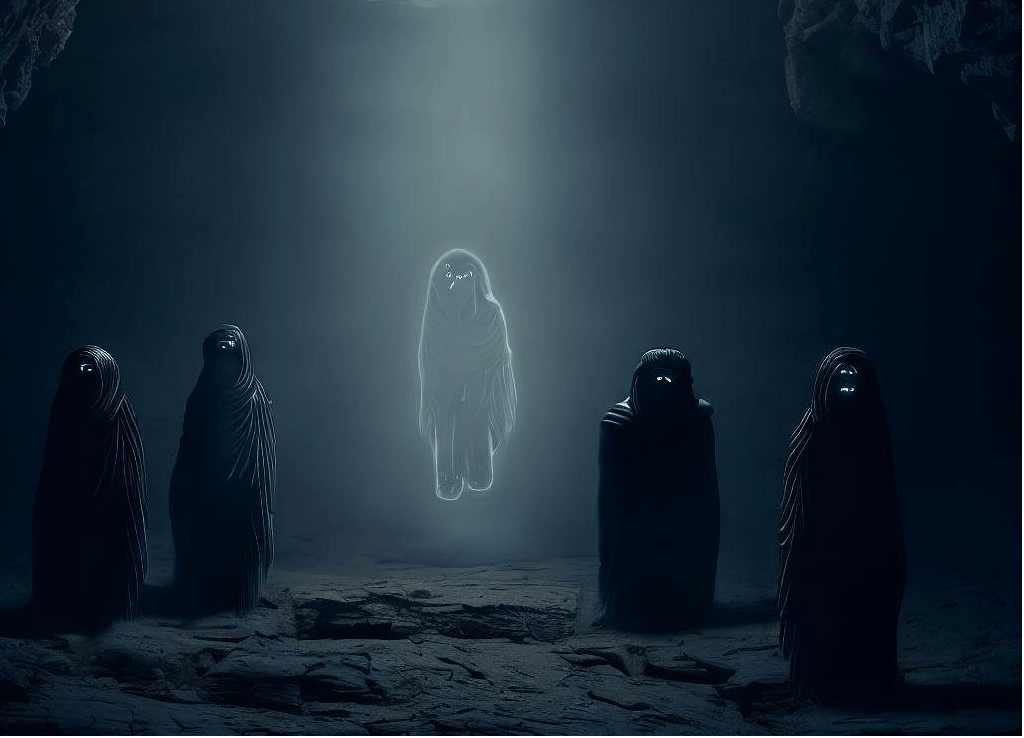
שְׁאוֹל (sheol) is a place where people move, visually see one another, and speak to one another (Isa 14:9-11; Ezek 32:21-23). In Isa 14:12-15, a being is cast out of שָׁמַיִם (“heaven, sky”) down to the bottom of a pit called שְׁאוֹל (sheol). Since heaven is stated to be the dwelling place of God in this text, it cannot be a reference to the physical sky but to the spiritual reality that is beyond the skies. The pit that this spiritual being is cast must then also be a spiritual reality.
- Isa 14:9-11 Sheol from beneath trembles excitedly over you to meet you when you come; It wakens for you the spirits of the dead, all the leaders of the earth; It raises all the kings of the nations from their thrones. They will all answer and say to you, “Even you have been made weak as we, you have become like us. Your pride and the music of your harps have been brought down to Sheol; Maggots are spread out as your bed beneath you and worms are your covering.”
- Ezek 32:21 The rulers among the mighty ones shall speak of him and his helpers from the midst of Sheol, “They have gone down, they lie still, the uncircumcised, slain by the sword.”
- Isa 14:12-15 How you have fallen from heaven, O star of the morning, son of the dawn! You have been cut down to the earth, you who have weakened the nations! But you said in your heart, “I will ascend to heaven; I will raise my throne above the stars of God, and I will sit on the mount of assembly in the recesses of the north. ‘I will ascend above the heights of the clouds; I will make myself like the Most High.” Nevertheless, you will be brought down to Sheol, to the recesses of the pit.
It is possible to understand Isa 4:9-11 and Ezek 32:21, which appear to talk about a spiritual afterlife, as really just being poetic descriptions of the grave for rhetorical effect, where corpses are being spoken of as doing things that corpses obviously do not do. However, it is highly unlikely for this to be the case because that same understanding can’t be applied to Isa 14:12-15. Also, the historical and cultural context in which the Old Testament was written does not support the poetic interpretation. The next part in our series on Hell will demonstrate that the historical and cultural evidence requires that these descriptions be taken as indicating a spiritual reality to שְׁאוֹל (sheol).
Putting it all together
Let’s take all that we’ve seen so far and try to form a unified understanding of the word שְׁאוֹל (sheol).
We saw that שְׁאוֹל (sheol) sometimes clearly refers to a grave where corpses rot, which is a place where the corpses of both the righteous and the wicked end up and where they neither speak, nor know, nor do anything (as expected of corpses).
We also saw that שְׁאוֹל (sheol) is closely associated with death as an abstract concept or perhaps as a false god (in the Baal religion, represented in the texts found in the city of Ugarit, death is a god), that one could make a covenant with.
If this was all that the Bible had to say, then we could argue understand שְׁאוֹל (sheol) to merely be the grave, which can be used in a metaphorical way to communicate the concept of death. However, we also saw that spiritual beings could be cast down from heaven into שְׁאוֹל (sheol), which means that שְׁאוֹל (sheol) can also refer to a spiritual realm. Not only that, but the spirits of departed people in שְׁאוֹל (sheol) are spoken of as seeing and interacting with others who have died.
So, we have to conclude that שְׁאוֹל (sheol) sometimes refers to:
(i) a literal grave
(ii) a metaphorical extension of the grave to the concept of death
(iii) a metaphorical extension of the grave to the spiritual realm of the dead that is opposite of Heaven where God dwells
What we have not seen here is whether שְׁאוֹל (sheol) as a spiritual realm is a place of punishment, a place of reward, a combination of the two, or something entirely neutral. It would actually be very strange for a word that refers to the grave, which is a pit that both the righteous and the wicked are put into, to be used to refer specifically to a place where only the wicked are punished.
Although an evil spiritual being and evil kings are said to be active in שְׁאוֹל (sheol) in Isaiah, that does not prove that only evil beings are in שְׁאוֹל (sheol). If I say that demons and evil business owners can be found in America, does that prove that everyone in America is evil and there are no Christians in America? Of course not! We have to be careful that we don’t bring our assumptions to the discussion and make ambiguous texts become clearer than they really are.
Up Next
In the next part of our series, we will consider the cultural and historical context that the Old Testament was written in, which will clear up much of the ambiguity that we have from looking at the Old Testament alone.
 VersesVersusVanity
Leave a comment